How to split a restaurant bill fairly when not everyone ate the same
Three ways to split a restaurant bill — equal, item by item, or a hybrid — how to make the service charge follow the food, and a worked four-person example in euros.
The bill arrives and the table goes quiet. One person had a main and tap water; another had two glasses of wine, a starter and a dessert. Someone says “shall we just split it four ways?” and the person who drank water does the sum in their head and decides it is not worth the conversation.
Once, it is not. Over a year of dinners it adds up, and it is one reason some people stop saying yes to group meals. The fix is not stricter accounting — it is picking a method that matches how different the orders were, and doing the split where everyone can see it.
The short version: split equally when the orders were roughly alike, split by item when they were not, and whichever you choose, make the service charge follow the food rather than the headcount.
Option 1 — Equal split: when the orders were similar
Dividing the total by the number of people is the fastest way to pay and the right default when everyone had a main and a drink of about the same price. The unfairness is a euro or two either way and it evens out across dinners. It stops being fair the moment the orders diverge — one person drank and another did not, only two people took dessert — because then the quiet person at the table is paying for someone else’s wine.
Option 2 — Item by item: when they weren’t
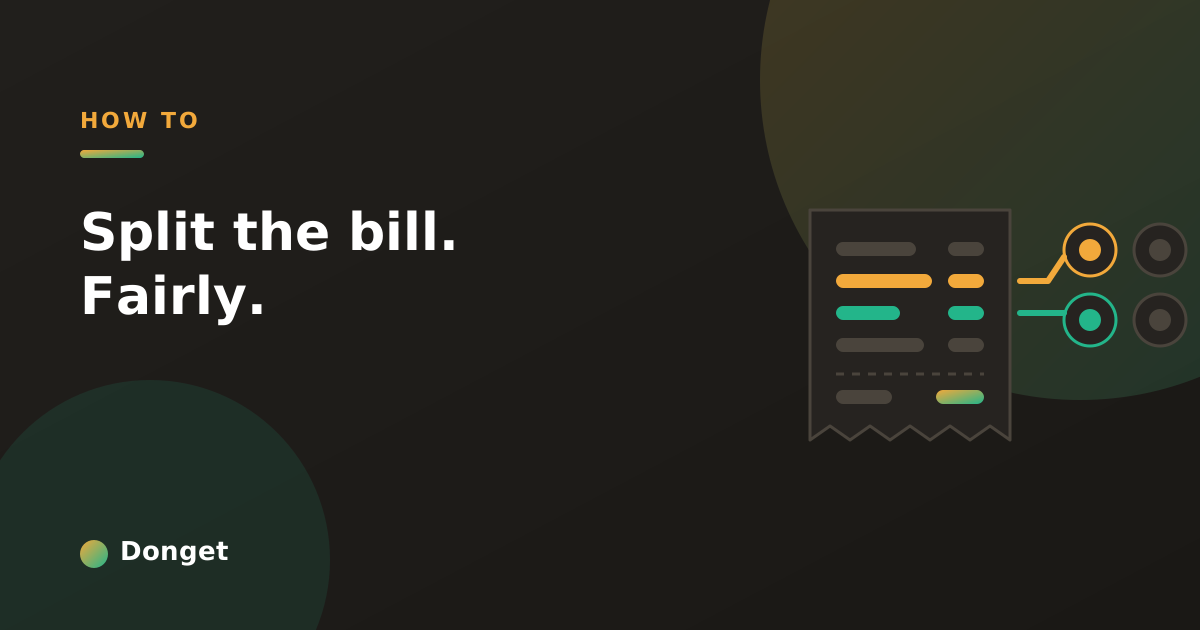
Each person pays for exactly what they ordered, plus their share of anything the table shared. It is the most accurate method, and the reason people avoid it — the bill being passed around while everyone squints at it — disappears once you photograph the receipt and assign each line to a person. It is the right call for a table of drinkers and non-drinkers, for the vegetarian who ordered the €16 main while the steaks were €24, and for any bill where people ordered very different numbers of courses.
Option 3 — The hybrid: shared lines equal, own lines by person
Most real dinners are a mix: bread for the table, a bottle shared by some, and mains and desserts that are clearly one person’s. The hybrid treats them accordingly — shared lines split equally among the people who shared them, individual lines stay with whoever ordered them. Default to this when you are not sure: it is item-by-item where it matters and equal where it does not. For the general version of these methods — equal, exact amounts, percentages, shares, item-by-item — the 5 ways to split an expense covers when each one fits.
Service charge and tax scale with what you ordered
This is the part that gets split wrong even by people who itemise carefully. A service charge is a percentage of the bill; so is any tax-like line printed on it. Split the food by item and then divide the service equally, and the person who ordered least is still subsidising the person who ordered most, just on a smaller amount.
So scale, don’t split: work out each person’s food-and-drink subtotal, then multiply every subtotal by the same factor — 1.10 for a 10 % charge, 1.125 for 12.5 %. Each person’s final figure then carries their share of the charge in proportion to what they ordered, and the figures add up to the printed total to the cent. Whether a service charge is included, added or left to you varies by country and restaurant; the arithmetic does not.
A worked example: four people, one bill
Maya, Tom, Priya and Leo have dinner. The restaurant adds a 10 % service charge.
- Maya: starter €8, main €18, two glasses of wine €14 — €40
- Tom: main €22, beer €6 — €28
- Priya: main €16, tap water — €16
- Leo: main €24, two glasses of wine €14, dessert €8 — €46
- Shared: bread for the table €6, split four ways — €1.50 each
Food and drink come to €136. The 10 % service charge is €13.60, so the total on the bill is €149.60.
Split equally, that is €37.40 each. Priya, whose food and bread came to €17.50, pays €37.40 — nearly twenty euros more than she ordered. Scaled by item, each subtotal is multiplied by 1.10:
| Ordered | Share of bread | Subtotal | × 1.10 (with service) | Equal split | |
|---|---|---|---|---|---|
| Maya | €40.00 | €1.50 | €41.50 | €45.65 | €37.40 |
| Tom | €28.00 | €1.50 | €29.50 | €32.45 | €37.40 |
| Priya | €16.00 | €1.50 | €17.50 | €19.25 | €37.40 |
| Leo | €46.00 | €1.50 | €47.50 | €52.25 | €37.40 |
| Total | €130.00 | €6.00 | €136.00 | €149.60 | €149.60 |
Check: 45.65 + 32.45 + 19.25 + 52.25 = 149.60, the printed total. Priya pays €19.25 instead of €37.40; Leo pays €52.25. The bread — the one genuinely shared line — went four ways; the wine, the biggest source of the gap, went to Maya and Leo, who drank it. That is the hybrid, with the service charge following the food.
How to do it at the table in two minutes
Not four cards at the till. One person pays the whole bill on one card — restaurants that will not split across four cards will almost always take one. Photograph the receipt before it disappears, because the line items are the whole job. Assign each line to a person, shared lines to whoever shared them, and scale everyone by the same service factor. Then settle later, not now: nobody needs to transfer €19.25 at the table, and the balance clears with the next shared cost or in one payment at the end of the month — settling up without the awkwardness covers closing a few of these at once. Decide once that shares round to the nearest ten cents, or that the payer absorbs the odd cents; a three-cent discrepancy is not worth a message thread.
The social rules: say it before you order
Almost every bill argument is a timing problem, not a maths problem. “Shall we each pay for what we order, and split the bread?” at the start is a neutral suggestion everyone nods at; the same sentence when the bill arrives sounds like a complaint about someone’s dessert. If the group agreed to split equally and one person ordered the steak, that was the agreement — change the method next time, not tonight.
The birthday case has two conventions — the guests cover the birthday person, or the birthday person treats everyone — and both are fine as long as it is said in advance. Who pays on a birthday dinner goes through it, including the itemised version.
If you paid, one message with the amount and the reason — “dinner on Friday, your share came to €32.45” — is all it takes. If that is the part you dread, how to ask a friend for money back has the wording.
Where Donget comes in
The itemised split is the one people skip because it used to mean arithmetic on a napkin. In Donget, whoever paid opens the group, adds a New Expense and chooses Scan receipt with AI: the photo becomes a draft expense with the lines already on it. In Items and Costs each line is assigned to whoever ordered it — Priya’s main to Priya, the two glasses to Maya, the bread to all four — and a line can be shared by some people and not others, which is exactly the hybrid. If you have already worked out the scaled figures, the same expense can instead be split by Amount, one number per person. How AI receipt scanning saves you time shows what the scan returns.
Paid by is whoever put their card down, Balances shows what each person owes them, and the split is done before anyone has stood up. Nobody needs to pay that night: the balances net against the next shared bill, and Settle up suggests the fewest transfers to clear whatever is left.
Frequently asked questions
Should you split the bill equally or by what each person ordered?
Equally when everyone ordered roughly the same; by item when the orders were clearly different, because an equal split then moves real money from the person who had water to the person who had wine and dessert.
How do you split the service charge or tip fairly?
Scale it rather than splitting it equally: multiply each person’s subtotal by the same factor (1.10 for 10 %) and the charge lands in proportion to what each person ordered.
What is the fairest way to split the bill when someone didn’t drink?
Take the drinks out of the shared pool: each person pays for their own drinks, and the food is split equally or by item depending on how alike the orders were.
Is it rude to ask to split the bill by item?
Not if it is said before the food arrives. At the start of the meal it is a neutral suggestion; when the bill lands, it sounds like a complaint.
What if the restaurant won’t split the bill across several cards?
Let one person pay the whole bill and split it between yourselves afterwards, somewhere everyone can see it.
How do you handle shared starters and a bottle of wine for the table?
Shared lines split equally among the people who shared them, individual lines by person: bread for four is 1.50 each; a bottle shared by three is a third each and nothing for the person on water.
Who pays when it’s someone’s birthday dinner?
Conventions differ, so the organiser says in advance whether the guests cover the birthday person or the birthday person treats. If the guests are covering, take the birthday person’s items off the bill and spread that amount across the others.
The bottom line
Equal when the orders were alike, by item when they were not, hybrid when the table shared some things and not others. Scale the service charge instead of dividing it by heads, say the method before anyone orders, and let one person pay so the split can happen somewhere everyone can see it.
Download Donget free and split the next dinner by item from a photo of the receipt, with one person paying and everyone seeing their share the same night.