How debt simplification works: why your group owes fewer payments than it thinks
How debt simplification turns a web of IOUs into net balances, why five friends settle in three transfers, and why you may owe someone who never paid for you.
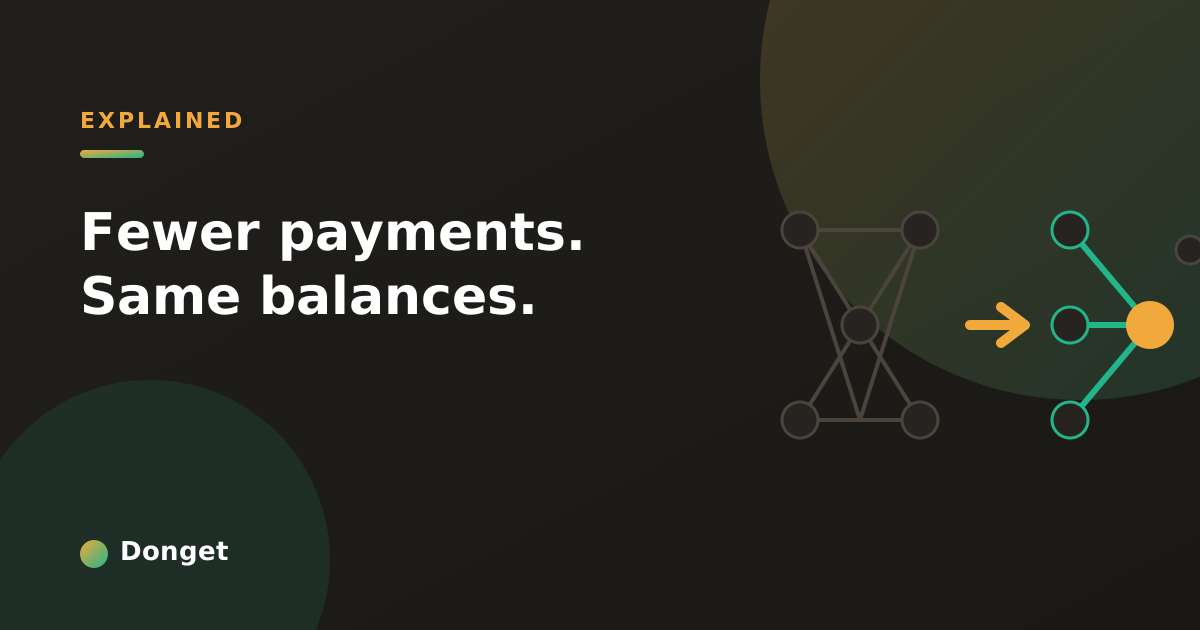
You open the group after a weekend away, tap settle up, and the app tells you to pay Ana €150. You never bought anything from Ana. You paid for the fuel, Ben did the groceries, and somehow the suggestion is one transfer to the person who booked the chalet. It feels as if the app has rearranged your debts behind your back.
It has, in a sense, and once you see how, you will never argue about it again: simplifying debts changes who pays whom, never how much anyone ends up in or out of pocket.
Two ways to describe the same weekend
There are two honest ways to write down what a group owes after a trip.
The first is pairwise IOUs: every expense creates a small debt from each person who shared it to the person who paid. Five friends share a chalet Ana paid for, so the other four each owe Ana a fifth of it; Ben buys the groceries, so Ana and three others each owe Ben a fifth of that. A dozen expenses later there are dozens of arrows criss-crossing the group, many pointing in opposite directions between the same two people — which is what keeping track of who owes you money by hand always turns into.
The second is net balances: one number per person — what they paid for the group, minus their share of everything the group spent. Positive means the group owes them; negative means they owe the group.
Both hold the same information. The pairwise version remembers the history; the net version remembers the result. Settling up is about the result.
The one number that matters: your net
Your net is the only figure that decides how much money leaves or enters your pocket. It does not care who you owe or who owes you, only the total. If you owe Ana 120 and Ana owes you 40, nobody expects two payments; you pay Ana 80 and you are done. Debt simplification is that instinct applied to the whole group at once rather than one pair at a time. It is also why a spreadsheet of shared expenses needs only a paid and a share column per person: the net is the difference.
Why the nets always add up to zero
Every euro anyone paid was somebody’s share. Ana’s €600 chalet is €120 of share for each of five people, Ana included. Add up what everyone paid and you get the group’s total; add up everyone’s shares and you get the same total. So the nets, positive and negative together, always sum to exactly zero — the people who are ahead are owed precisely what the people who are behind owe. The money to clear the group already exists inside it.
From nets to transfers
The nets split the group into creditors (positive, owed money) and debtors (negative, owing money). A transfer moves money from a debtor to a creditor and shrinks both numbers towards zero. The standard method, which is also the one you would invent on a napkin:
- Take the person who owes the most and the person who is owed the most.
- The debtor pays the creditor the smaller of the two amounts. At least one of them is now at zero and drops out.
- Repeat with whoever is left until every net is zero.
Every transfer retires at least one person, so a group of n people needs at most n − 1 transfers, and usually far fewer, because several debtors often clear against one creditor. Nothing is reassigned; the transfers are simply a short route from the nets to zero.
A worked example: five friends, one chalet
Ana, Ben, Cem, Dara and Eli spend a ski weekend together and split everything equally.
| Expense | Paid by | Amount | Each person’s share |
|---|---|---|---|
| Chalet | Ana | €600 | €120 |
| Groceries | Ben | €200 | €40 |
| Dinner out | Cem | €150 | €30 |
| Fuel | Dara | €50 | €10 |
| — | Eli | €0 | — |
| Total | €1,000 | €200 |
Pairwise, each expense creates four IOUs to whoever paid it: four people owe Ana €120 for the chalet, four owe Ben €40 for groceries, four owe Cem €30, four owe Dara €10. Sixteen IOUs. Even after cancelling the opposite arrows within each pair, all ten pairs still owe something — Ben owes Ana €80, Cem owes Ana €90, Dara owes Ana €110, Eli owes Ana €120, Cem owes Ben €10, and so on. Ten payments.
Nets are simpler. Each person’s share of the €1,000 is €200:
| Person | Paid | Share | Net |
|---|---|---|---|
| Ana | €600 | €200 | +€400 |
| Ben | €200 | €200 | €0 |
| Cem | €150 | €200 | −€50 |
| Dara | €50 | €200 | −€150 |
| Eli | €0 | €200 | −€200 |
Check: 400 − 50 − 150 − 200 = 0. The group owes Ana exactly what Cem, Dara and Eli owe the group.
Simplified, the matching takes three steps: Eli (owes most) pays Ana (owed most) €200; Dara pays Ana €150; Cem pays Ana €50. Ana has her €400, every net is at zero, and the group is clear. Three transfers instead of ten.
Look at Ben. On paper he owes Ana €120 for the chalet and is owed €40 by each of four people for the groceries. He owes €160 and is owed €160, so his net is zero and the plan leaves him out entirely. He pays nothing and receives nothing, which is right: nothing he did changed his position.
Why you end up paying someone you never bought anything from
Take the smallest version of the situation. Ana covers Ben for €30; later, Ben covers Cem for €30. Pairwise: Ben owes Ana, Cem owes Ben — two payments, with Ben receiving €30 from Cem and handing €30 to Ana. Nets: Ana +30, Ben 0, Cem −30. Simplified: Cem pays Ana €30, and Ben is untouched.
Cem ends the weekend €30 down in both versions; Ana ends it €30 up in both. All simplification removed was Ben’s role as a pass-through. Cem “owes Ana” not because Ana bought him anything, but because Ana is where the money he owes the group is supposed to land. The routing is shorter; the fairness is identical.
The trade-off, and the opt-out
The cost of simplification is social, not mathematical. On a big trip you may be told to pay €40 to a friend of a friend you spoke to twice, instead of the person who actually bought your ski pass. Some people dislike that, and they are allowed to.
If your group would rather pay back exactly who covered them, do it: record each direct repayment and the balances reach zero anyway, in more steps. Simplification is a suggestion about the fewest transfers, not a rule about who is responsible for whom. Either way, what keeps a group calm is settling on a rhythm rather than a feeling, so balances never sit long enough to become a story.
And because it all runs on nets, how the shares were produced does not matter: equal, exact, percentage or item-by-item splits all end in one net per person — including on a trip where some costs are shared by only part of the group.
Where Donget comes in
In a Donget group, the Balances tab shows Everyone’s balance: one net per member, positive or negative, updated as expenses are added and synced to everyone. Tap Settle up and the app suggests the fewest transfers that bring every net to zero.
Recording a payment is a Transfer; each one moves two balances towards zero until the group is clear. If your group prefers to pay pairwise, record those transfers instead — the balances stay correct either way. Moving from another app with a balance still open? Carry it across as one opening expense and the nets pick up where they left off.
Frequently asked questions
Does simplifying debts change how much I owe?
No. It only changes who you pay, never how much. Your net — what you paid minus your share of what the group spent — is the same before and after, and so is everyone else’s.
Why do I owe someone I never bought anything from?
Because your debt to one person and their debt to a third cancel through the middle. If Ana covered Ben for 30 and Ben covered Cem for 30, Ben is even, so Cem pays Ana directly; Cem ends 30 down and Ana 30 up either way.
Is the simplified result always the smallest possible number of payments?
It is at most one fewer than the number of people in the group, and usually far fewer. Finding the absolute minimum in every case is a harder problem, but for a group of friends the difference is rarely more than one payment.
Can we just pay each other directly instead?
Yes. Simplification is a suggestion, not a rule. If your group prefers that everyone pays back the person who covered them, record those payments; the balances reach zero either way, in more steps.
What if one person paid for almost everything?
Then the plan is as short as it gets: everyone who is behind pays that one person, and nobody else moves money — the ski weekend case, three transfers for five people, all landing with whoever booked the chalet.
What happens if someone adds an expense after we’ve settled?
It creates fresh net balances from zero, and the next settle-up suggestion is based on those. Payments you already recorded stay recorded; nothing needs undoing.
The bottom line
Debt simplification is not a trick. It drops the history of who covered whom, keeps the one number per person that decides the money, and finds a short path from those numbers to zero. Five friends with ten pairwise debts settle in three transfers, and everyone ends exactly as far ahead or behind as before.
Download Donget free and let Settle up find the fewest transfers the next time a group of you goes away.