How to split an Airbnb or villa with friends when rooms and nights aren't equal
Person-nights, a room premium agreed up front, and one settle-up for whoever booked: how to split an Airbnb or villa fairly between couples, singles and early leavers.
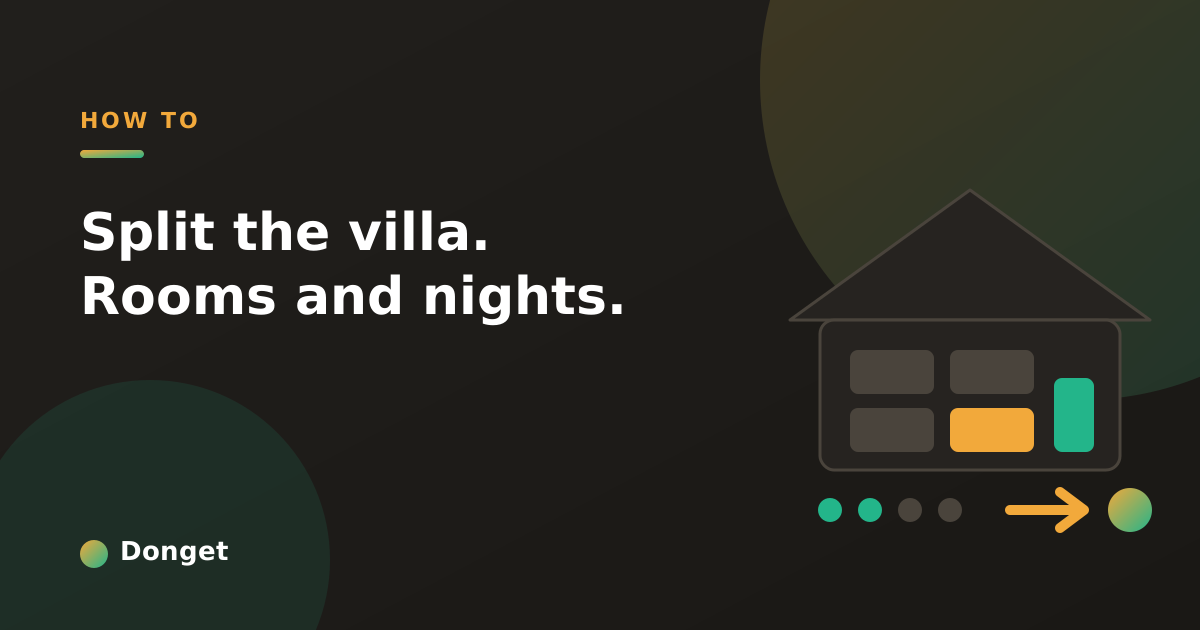
Six of you found a villa for four nights. Two are a couple and want the en-suite, one can only make the first two nights, and one person’s card took the whole €2,200 at booking. Now somebody has to say what each person owes, and “just divide by six” is wrong in three ways at once.
The fix is not a formula. It is a unit and an order of operations: count person-nights, not heads; agree any room premium before anyone unpacks; then pay the booker back in one round, not six trickling transfers.
The unit is the person-night, not the head
A rental is priced per night for the whole house. Someone there for two of four nights used half the house-time of someone who stayed the whole trip, so “equal” should mean equal per night present, not equal per name on the booking.
Total rent ÷ total person-nights gives a price per person-night; multiply it back by each person’s nights. An early leaver pays exactly the fraction they were there for, and everyone else pays slightly more than total ÷ heads to cover it — that is the point, not a rounding error.
It only holds if the partial stay was genuinely partial. A bed held empty is still a bed booked; if Lena’s room could have gone to a seventh friend, that is a conversation for before booking, not after.
Price the rooms before anyone unpacks
The en-suite with the balcony and the box room beside the boiler are not the same product, and pretending they are is how the box room spends four days quietly resentful.
Agree the premium as one total figure — “the en-suite is worth €140 more over the trip” — and take that amount off everyone else in proportion to their person-nights. The premium funds the discount, so the house total does not change. Do it once, at the start, and tie it to the room, not the people: whoever ends up with the view pays for the view.
How much? No number holds across houses. Start from the figure that would make you content in the worst room, and adjust until nobody flinches. For a more structured way to rank rooms, the method in splitting rent when rooms aren’t equal carries across directly — swap months for nights.
Couples: by person or by room?
Two conventions exist. By person: a couple is two people using two person-nights every night, so they pay two shares. By room: each bedroom pays an equal slice and the couple halves theirs — cheaper for the couple, dearer for the singles.
By-room holds up when every single has a private room and the bedrooms genuinely drive the price. It collapses the moment two singles share a twin, someone takes the sofa bed, or the couple’s room is also the nicest. Person-nights plus an explicit room premium survives every layout: the couple pays for two people because the kitchen and the pool don’t care how many bedrooms there are, and the premium covers the fact that they also got the best room. That is the convention in the example below.
A worked example: six friends, four nights, one en-suite
Sara and Omar are a couple and take the en-suite. Lena leaves after two nights. Jonas booked the villa and paid the full €2,200 on his card. Mia and Kai stay all four nights.
Step 1 — person-nights. 4 + 4 + 2 + 4 + 4 + 4 = 22. €2,200 ÷ 22 = €100 per person-night: €400 each, €200 for Lena.
Step 2 — the room premium. The group agreed the en-suite is worth €140 more, so Sara and Omar add €70 each. The €140 comes off the other four by person-nights: 2 + 4 + 4 + 4 = 14, so €10 per person-night — Lena −€20, Jonas, Mia and Kai −€40 each.
| Person | Nights | Base share | Room adjustment | Final share |
|---|---|---|---|---|
| Sara | 4 | €400 | +€70 | €470 |
| Omar | 4 | €400 | +€70 | €470 |
| Lena | 2 | €200 | −€20 | €180 |
| Jonas | 4 | €400 | −€40 | €360 |
| Mia | 4 | €400 | −€40 | €360 |
| Kai | 4 | €400 | −€40 | €360 |
| Total | 22 | €2,200 | 0 | €2,200 |
Step 3 — settle with the booker. Jonas paid €2,200 and his own share is €360, so he is owed €1,840. Five transfers clear it: Sara €470, Omar €470, Lena €180, Mia €360, Kai €360 — which sum to €1,840. With one person owed and five owing, five is also the fewest transfers possible. And anyone can reproduce every number from the nights and the one agreed premium, which is what makes the split hold up when someone asks, a week later, “why am I paying more than Lena?”
The booker fronted everything — settle early and separately
Jonas put €2,200 on a card weeks before anyone packed. That is a favour, and the way to repay it is speed, not a discount: settle the rental as soon as the split is agreed, as its own round, before the holiday tab starts.
Keeping it separate matters. Merged into the same running balance as groceries and dinners, Jonas’s €1,840 credit dominates everything: whoever bought the wine for the house ends up paying Jonas instead of being paid back by the group — arithmetically correct, but it invites “why am I paying him?” Settle the house first, then run the rest of the trip on its own balance, the way the fair way to split a group trip lays out; if some of you drive down together, fuel and tolls have their own rules, because people join and leave the car just as they join and leave the house.
One message — “the villa came to €2,200, the split is attached, here’s how to pay me” — lands better than five separate nudges; settling up without awkwardness covers the wording.
Cleaning fee, deposit and the extras
Cleaning fee. It usually sits inside the booking total and it is a cost of the house, so split it like the rent, by person-nights. Some groups split it by head instead, because mess does not scale with nights. Either is fine; the only mistake is not saying which.
Deposit. A deposit is supposed to come back, so it is not split at all: the booker fronts it and receives it. If part is withheld, split the withheld amount when that happens — by person-nights, or by whoever broke the thing if that is clear and agreed.
A different currency. If the house is abroad, the booking was probably charged in another currency; pick one home currency for the group and log the rental in that — splitting bills across currencies goes through the rest. And if the trip has a guest of honour whose share the others are covering, budgeting a bachelor or bachelorette trip is the split to use instead.
Where Donget comes in
Create a group for the trip and share the Invite link; each friend previews the group and picks their name on the way in. Add the villa as one expense, Paid by Jonas, €2,200, and split it by Multiplier with each person’s nights as their shares — 4, 4, 2, 4, 4, 4 — so the €400 and €200 base shares fall out on their own. Once the room premium is agreed, switch the same expense to Amount and type the final figures: 470, 470, 180, 360, 360, 360.
Everyone’s balance then shows what each person owes Jonas, and Settle up lists the five transfers. When someone pays him, recording it as a Transfer moves that balance to zero for everyone at once. Groceries and dinners go in as they happen, split among the people who were there.
Frequently asked questions
Should a couple pay per person or per room in a shared Airbnb?
Both conventions exist. Per person survives most house layouts; per room suits a house where every bedroom has one occupant. Pick one before booking and say it out loud.
How do you split an Airbnb when someone stays fewer nights?
Count person-nights instead of heads: divide the total by the sum of everyone’s nights, then multiply by each person’s nights. Two of four nights is half a full share.
How much extra should the best room pay?
No formula holds across houses. Agree one total premium before anyone unpacks and spread it as a discount across everyone else by person-nights.
Who pays the cleaning fee on a shared Airbnb?
It is a cost of the house, so split it like the rent, by person-nights. Some groups split it by head instead — either works if it’s agreed.
How should we handle the security deposit?
Don’t split it; it comes back. The booker fronts it and receives it. If part is withheld, split the withheld amount when it happens.
Should the person who booked get a discount for the effort?
Not by default; booking is a favour, not a cost. What the booker is owed is to be paid back early, in one round. A thank-you dinner is cleaner than a hidden discount.
The bottom line
Three decisions in the right order: count person-nights rather than heads, agree the room premium as one figure before anyone unpacks, and pay the booker back in a single round before the holiday spending starts. Get those right and the numbers explain themselves.
Download Donget free and split the next villa by nights and rooms in one expense, with the settle-up worked out before you’ve found the pool.