When one of you pays for everything: how to rebalance
One person's card comes out every time and nobody decided it. How to tell an income gap from drift from avoidance — and the proportional split that actually fixes it.
It’s the automatic part that gets to you.
Not the €40 at the supermarket. The fact that your hand went to your pocket without either of you looking up. It’s been going to your pocket for eleven months, and somewhere in there it stopped being a kind thing you were doing and became the arrangement — one that nobody proposed, nobody agreed to, and nobody can now mention without it sounding like an accusation.
You’re not annoyed about the money. You’re annoyed that it was decided without a decision.
Good news: this is one of the more fixable things in a relationship, provided you correctly identify which of three completely different problems you actually have. Most advice fails because it assumes everyone has the same one.
Three situations that feel identical from the inside
1. There’s an income gap. One of you earns significantly more. Splitting everything down the middle looks fair and isn’t: the same €800 takes a very different bite out of two very different salaries. Here the person paying more is doing something reasonable — it’s just happening informally, without being named, which is what makes it feel unstable.
2. It drifted. Incomes are roughly comparable. It just… happened. Your card was on file for the groceries, you booked the trip because you were the one at a laptop, and eleven months later there’s a pattern nobody chose. This is the most common version by a wide margin, and the least serious — but it’s the one that quietly generates the most resentment, because there’s no reason for it, which makes it feel like it means something.
3. One person is avoiding it. Consistently absent when a bill arrives. Vague about their finances. Reliably short. This is not a budgeting problem and no app will solve it.
Read those again and pick honestly. Applying the fix for one to another is exactly how a small money conversation turns into a large one.
If it’s an income gap: split proportionally, not equally
The most useful idea in shared finances, and it takes one minute to explain.
Instead of halving the shared costs, each person contributes in proportion to what they earn. Same percentage of income, not same number of euros.
Say one of you takes home €2,800 a month and the other €1,700. Shared costs — rent, bills, food, the joint stuff — come to €1,600.
Split 50/50: €800 each.
- The higher earner keeps €2,000 of €2,800 — 71% of their income.
- The lower earner keeps €900 of €1,700 — 53% of theirs.
One of you has twice the spare money of the other, from an arrangement described as equal.
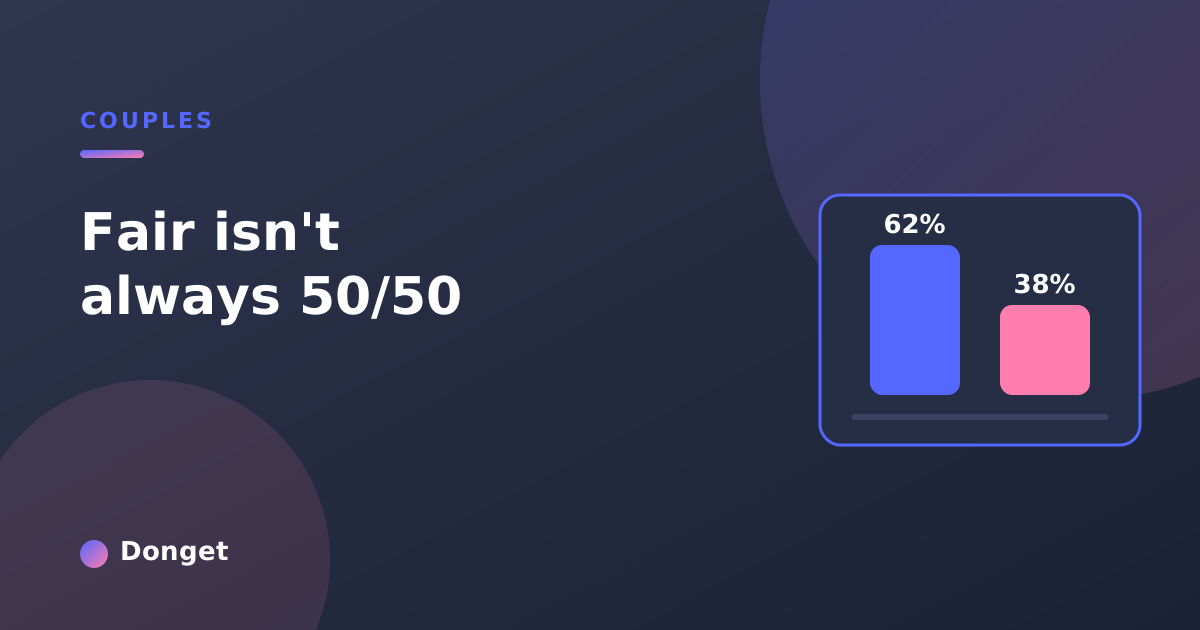
Split proportionally: combined income is €4,500, so the shares are 62% and 38%.
- Higher earner pays €996. Keeps €1,804 — 64% of their income.
- Lower earner pays €604. Keeps €1,096 — 64% of their income.
Identical. Not identical amounts — identical pressure. Both of you feel the same about the month.
That’s the whole argument, and it’s why proportional splitting tends to end this conversation permanently rather than deferring it. It also removes the thing that makes the informal version corrosive: the higher earner is still paying more, but now it’s a rule rather than a favour, and favours are the things that get remembered and counted.
Run your own numbers before the conversation. “I did the maths and it’s 62/38” is a far easier thing to hear than “I feel like I pay for everything.”
If it drifted: name it, don’t litigate it
With comparable incomes, the fix is administrative — but only if you resist the urge to prove the case first.
The instinct is to arrive with evidence. Eleven months of receipts. A total. Do not do this. The moment you produce a ledger, your partner is a defendant, and people defend themselves rather than agree with you.
What works is shorter and more boring:
“I’ve noticed my card is the one that comes out for pretty much everything, and I don’t think either of us actually decided that. Can we set something up so it’s not on one of us?”
Three things that make it land: it describes a pattern rather than a fault, it explicitly removes blame from both of you, and it ends with a request instead of a verdict. Nobody has to admit anything to say yes to it.
Then set up the mechanism the same evening, while the goodwill is fresh. A conversation that doesn’t produce a system is a conversation you’ll be having again in March.
The mechanism: three pots
The structure that works for most couples, from very simple finances to very tangled ones:
Yours. Mine. Ours.
Ours covers what you genuinely share — rent, bills, food, the sofa, the holiday. Funded either equally or proportionally, depending on which of the situations above you’re in.
Yours and mine are the rest: clothes, gifts, hobbies, the things you’d buy regardless of who you lived with. No visibility required, no justification, no discussion.
The reason this works isn’t the accounting. It’s that it creates a clear boundary around what’s up for discussion. Without one, every purchase is potentially a shared concern, and that’s exhausting for both people — the one being asked and the one who feels they have to ask.
Practically:
- List the shared costs. Sit down once with a bank statement, and be honest about the awkward middle cases: is the streaming subscription shared? The car? The cat? There’s no right answer, only a decided one.
- Pick equal or proportional. Use the calculation above.
- Log shared spending as it happens. Not from memory at month end. Both of you should be able to see the same balance without asking each other.
- Settle on a fixed day. Payday works. The date is what removes the asking.
Step four is the one people skip and the one that does the work. When there’s a scheduled settle-up, nobody ever has to raise it — and having to raise it is the entire problem you’re trying to solve.
Don’t do it from memory
A note on the mechanism itself, because it’s where good intentions usually die.
Memory is not neutral. Everyone remembers what they paid for far more vividly than what was paid for them — this is a well-documented bias, not a character flaw, and it applies to both of you simultaneously. Two people can each sincerely believe they’re contributing more, and both be sincere.
Which is why the fix has to be something you can both look at. Not a spreadsheet one of you maintains — that just relocates the imbalance into admin. Something shared, where an expense gets logged in a few seconds and both of you see the same number.
Once that exists, the topic mostly disappears from your relationship, which is the actual goal. Nobody wants a good system for discussing money. They want to stop discussing it.
What money isn’t measuring
Worth saying, because a proportional split can quietly obscure it.
Some contributions never appear on a bank statement. The person who tracks when the insurance renews, remembers both families’ birthdays, notices the milk’s gone, holds the mental map of the household — that’s real labour, it takes real time, and it is very unevenly distributed in most couples.
If one of you is contributing less money and more of that, the accounts aren’t the whole picture and the split shouldn’t pretend they are. Equally, if one of you is doing more of both, the money conversation isn’t the one you need.
Worth naming explicitly while you’re setting this up, since it’s much easier to say now than during an argument about groceries.
If it’s avoidance
Briefly, because it deserves honesty rather than a workaround.
If one person consistently won’t engage — vague about income, absent when bills land, defensive when it comes up — the imbalance isn’t the problem. It’s the symptom. Better tracking will make it more visible, not better, and there’s a real risk that a shared app becomes another thing to feel surveilled by.
That’s a conversation, and sometimes a conversation with someone outside the relationship. It isn’t a feature request.
Where Donget fits
For situations one and two, the mechanical part is genuinely easy, and Donget is free:
- A group for the two of you, with only shared costs in it — yours and mine stay private.
- Split by percentage — set 62/38 once and every shared expense divides that way automatically, with no monthly recalculation.
- Free receipt scanning, so logging the weekly shop is one photo rather than a chore either of you will skip.
- Both of you see the same balances in realtime. No ledger, no memory, no “but I thought I paid that”.
- Settle up on your fixed day, in the fewest payments.
There’s more on the couples use case page, and expense splitting for couples covers the setup in detail.
The point
Not to get even. Two people who love each other should not be trying to reach a balance of zero.
The point is that neither of you should be keeping a private tally — because a private tally is what’s actually happening right now, in the version where it’s automatic and nobody’s said anything. That tally is doing far more damage than €40 at a supermarket ever could.
Make it visible, agree the rule once, and let it stop being something either of you thinks about at the checkout.
Frequently asked questions
How should couples split expenses when one person earns more?
Proportional splitting usually feels fairest: each partner contributes the same share of their income rather than the same amount, so the higher earner pays more but neither is stretched. Fifty-fifty only feels fair when incomes are close.
Is it normal for one partner to pay for everything?
It’s extremely common, and it usually starts by accident rather than agreement. The problem isn’t the money itself — it’s that an unspoken arrangement quietly builds resentment. Naming it and choosing a split on purpose fixes most of it.
How do you split expenses fairly in a relationship?
Decide the method out loud — proportional by income, by category, or fifty-fifty — track shared costs in one place instead of from memory, and settle regularly so no one is silently subsidising the other.
What’s the fairest way to divide bills as a couple?
There’s no single answer, but the fairest split is the one you both agreed to and can see. Splitting proportionally by income, or by category (one covers rent, the other groceries), both work when they’re explicit and tracked.
How can an app help couples who split unevenly?
An app records who paid what, so the balance is a fact on a screen rather than a memory to argue about. Donget lets you split proportionally or by exact amounts and settle up in a tap — free, with no ads.
Download Donget free and set up your shared group in about a minute.