Should couples split bills 50/50? How to choose the split that fits
Should couples split bills 50/50? Yes, when your incomes and spending habits are close. When they are not, a proportional or hybrid split is usually fairer. Five questions help you choose.

One of you suggested splitting everything down the middle and it sounded obviously fair. A few months later, one of you is quietly skipping dinners out and the other has stopped suggesting them, and neither of you has said why.
The question underneath is simple: should couples split bills 50/50, or is there a better rule for the two of you? Split bills 50/50 when your incomes and spending habits are close and you both want separate finances. When one income is clearly larger, an equal split leaves the lower earner with much less to live on, and a proportional or hybrid split usually fits better. Agree the rule first.
When 50/50 works
An equal split is the easiest rule there is. Nobody needs to know the other’s salary, every bill is half each, and anyone can check the arithmetic. It fits three situations well.
Your incomes are close. If you take home roughly the same, half of the rent costs each of you about the same share of your pay. Equal amounts mean equal effort.
The relationship is new, or your lives are mostly separate. Early on, many couples prefer not to open their payslips to each other. Splitting 50/50 keeps finances private while you still share the costs fairly.
Your spending habits match. If you both want the same kind of flat, the same groceries and the same holidays, neither person is paying for the other’s preferences.
When 50/50 quietly stops working
The trouble starts when income gaps and spending habits stop lining up. Equal amounts are not equal effort when one person earns half as much again as the other. There are two ways this goes wrong, and couples often only notice one.
The higher earner sets the lifestyle. The flat, the restaurants and the weekend away are chosen at the level one person can easily afford. The other pays half of every bill and runs short each month.
The lower earner sets the lifestyle. The reverse is quieter. To keep half of every bill affordable, the couple shares a lifestyle sized to the smaller income, and the higher earner pays for anything above that alone. Neither person is wrong, but this is not the life either of you would have chosen.
In both cases the shared budget is decided by one person’s income. Most 50/50 relationship finances run fine. The problems start in the gap between equal amounts and unequal room left over.
Proportional vs 50/50: the same month, worked out
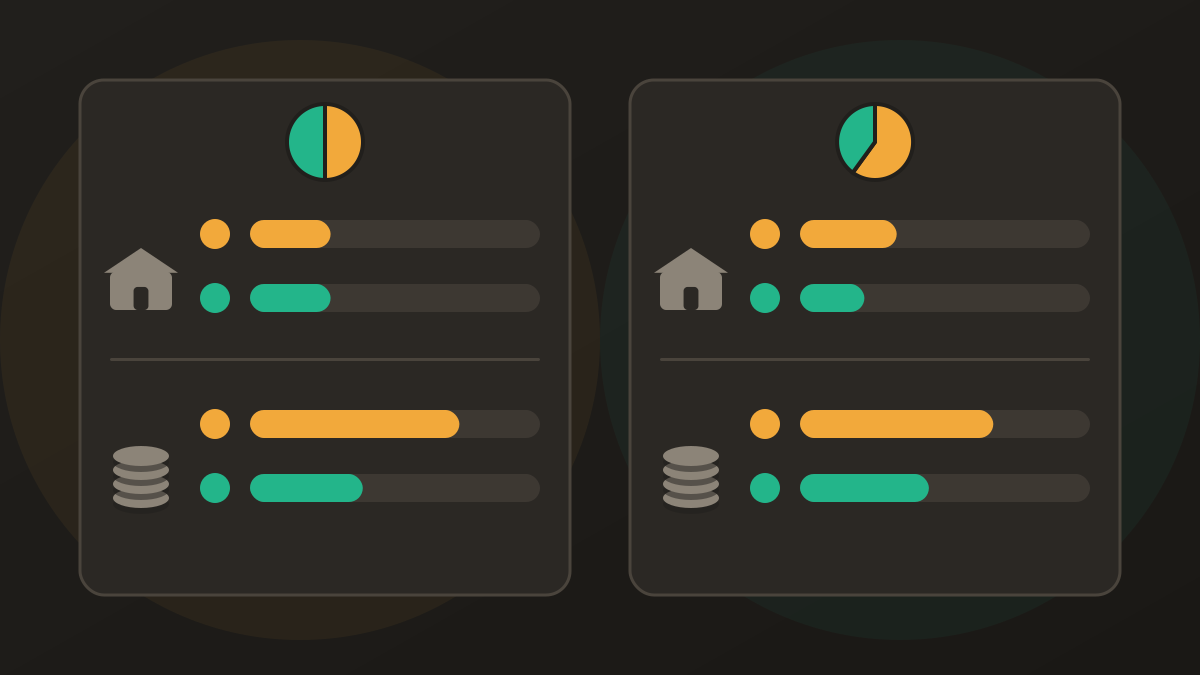
Sam takes home €3,600 a month and Alex €2,400. Together they earn €6,000, so Sam earns 60% of it and Alex 40%. Their shared costs (rent, bills, groceries and their meals out together) come to €2,000 a month.
| 50/50 | Proportional (60/40) | |
|---|---|---|
| Sam pays | €1,000 | €1,200 |
| Alex pays | €1,000 | €800 |
| Sam has left | €2,600 | €2,400 |
| Alex has left | €1,400 | €1,600 |
| Share of pay going to shared costs | Sam 27.8%, Alex 41.7% | both 33.3% |
Under 50/50, Alex gives up more than two-fifths of their pay and Sam just over a quarter, and Sam ends the month with €1,200 more than Alex. Under the proportional split, both give the same third of their pay. Sam pays €200 more, Alex €200 less, and the gap in what is left narrows to €800. Neither person is subsidising the other. They are contributing the same fraction.
The full method, including a version that subtracts each person’s unavoidable costs first, is in how to split bills when you earn different amounts.
The three alternatives to 50/50
Proportional to income. Each person pays their share of your combined take-home pay, as in the table. It is the most even in effort, and it means sharing your income figures with each other.
A hybrid: one rule for essentials, another for extras. Split the basics (rent, energy, groceries) 50/50 and the extras by income: dinners out, trips, the nicer option when you upgrade something. This suits couples whose essentials are affordable on either income and whose costs only diverge on extras. If Sam and Alex’s €2,000 were €1,500 of essentials and €500 of extras, Sam would pay €750 + €300 = €1,050 and Alex €750 + €200 = €950. Other couples run it the other way round, splitting the fixed costs by income and the fun equally. Either works, as long as you both agree which bucket a cost belongs to.
Each covers whole categories. Sam pays the rent (€1,200); Alex pays the bills, groceries and meals out (€800 in an average month). That lands on exactly 60/40, without a transfer. The catch is drift: if groceries run €100 higher one month, Alex’s side becomes €900 and the split is 57/43. Check it every few months.
The five ways to split an expense lists the remaining options if you need a different split for a particular cost.
Should couples split bills 50/50? Five questions to decide
- Is one take-home pay noticeably higher than the other? If not, 50/50 is usually fine.
- Who is choosing the shared costs? If the costs are set at one person’s comfort level, the other needs a split that matches their share.
- Are you both comfortable sharing your income figures? If not, the hybrid or category approach works without either of you seeing a payslip.
- Do your essentials and your extras behave differently? If the basics are affordable for both of you and only the extras diverge, use the hybrid.
- Would either of you resent the other rule? A split one person grudgingly accepts tends to fail within months. Pick the rule you can both explain without sounding defensive.
If you get stuck on question two, it is often a sign that one of you has been paying for everything without either of you deciding it. If you are about to share a flat for the first time, moving in together covers the deposit and the first big purchases.
Where Donget comes in
Whatever rule you choose, the hard part is that the bills never arrive at the same time or from the same card. In a Donget group for the two of you, each cost goes in under Add expense with Paid by set to whoever paid. Choose Equal for a 50/50 cost or Percentage for 60 and 40. Multiplier with 3 and 2 gives the same 60/40 split. A hybrid is simply different split settings on different expenses.
Say in one month Sam pays the rent (€1,200) and the utilities (€300), and Alex pays the groceries (€350) and the meals out (€150). Split 60/40, the Balances tab shows Sam €300 ahead. Split 50/50, it would show €500. Settle up turns that into one transfer from Alex to Sam, and Paid records it. The app does not move money. It keeps a record you can both see. The wider guide to expense splitting for couples covers settling on a regular rhythm.
Frequently asked questions
Should couples split bills 50/50?
When incomes are close, habits are similar and you want separate finances, yes. With a clear income gap, an equal split leaves the lower earner with much less, and a proportional or hybrid split usually feels fairer.
What is the difference between proportional and 50/50?
50/50 divides each bill into two equal amounts. Proportional divides it by each person’s share of combined income: €3,600 and €2,400 give 60% and 40%, so each gives the same fraction of their pay.
Is 50/50 fair in a relationship if one partner earns more?
It is equal, but it may not be fair. The same amount is a small part of one income and a large part of the other, and the gap in what each has left grows.
Can we use 50/50 for some bills and proportional for others?
Yes. A common hybrid splits the basics equally and the extras by income, or the reverse. Agree which rule applies to which cost before the bills arrive.
What if we each just cover different bills?
It is simple and works when the totals land roughly where you want. Variable bills drift, so check the ratio every few months.
How often should couples revisit how they split bills?
When an income, a rent or your living situation changes, and otherwise about once a year.
The bottom line
A 50/50 split is right when it means the same effort for both of you, which is when your incomes and spending habits are close. When they are not, split by income, use a hybrid or divide up the categories. However you split bills with your partner, choose the rule together, write it down and review it when your circumstances change.
Download Donget free and keep your shared costs in one list where the split you agreed is applied to every bill.