How to split bills when you earn different amounts
Fifty-fifty stops being fair when one income is half the other. Here are the two proportional methods households actually use, worked through in full, and where equal splitting still belongs.
The rent notice does not know that one of you earns half of what the other does. It asks for one number, and the moment you divide it down the middle, that number means two completely different things: an annoyance for one person, and the reason the other stops buying lunch.
This is not a fight about generosity. It is an arithmetic mismatch — splitting the amount equally while the impact is wildly unequal. There are two well-worn ways to fix it, both simple, and the choice between them matters far less than agreeing on one out loud.
Why equal splitting breaks
Take shared costs of €1,800 a month. Split evenly, that is €900 each.
For someone taking home €3,600 net, €900 is a quarter of the month. For someone taking home €2,400, the same €900 is more than a third — and the third is carved out of a smaller amount to begin with. After the shared costs, one person has €2,700 left and the other has €1,500. The gap between the two of you did not just persist; the flat rent widened it.
That is the whole problem, and it is why the fix is a percentage rather than a subsidy. Whether 50/50 still suits you as a couple is a separate choice, and should couples split bills 50/50? helps you make it.
Method 1 — split by share of income
Add both net incomes, work out each person’s share of the total, and apply those percentages to the shared costs.
| Person A | Person B | |
|---|---|---|
| Net monthly income | €2,400 | €3,600 |
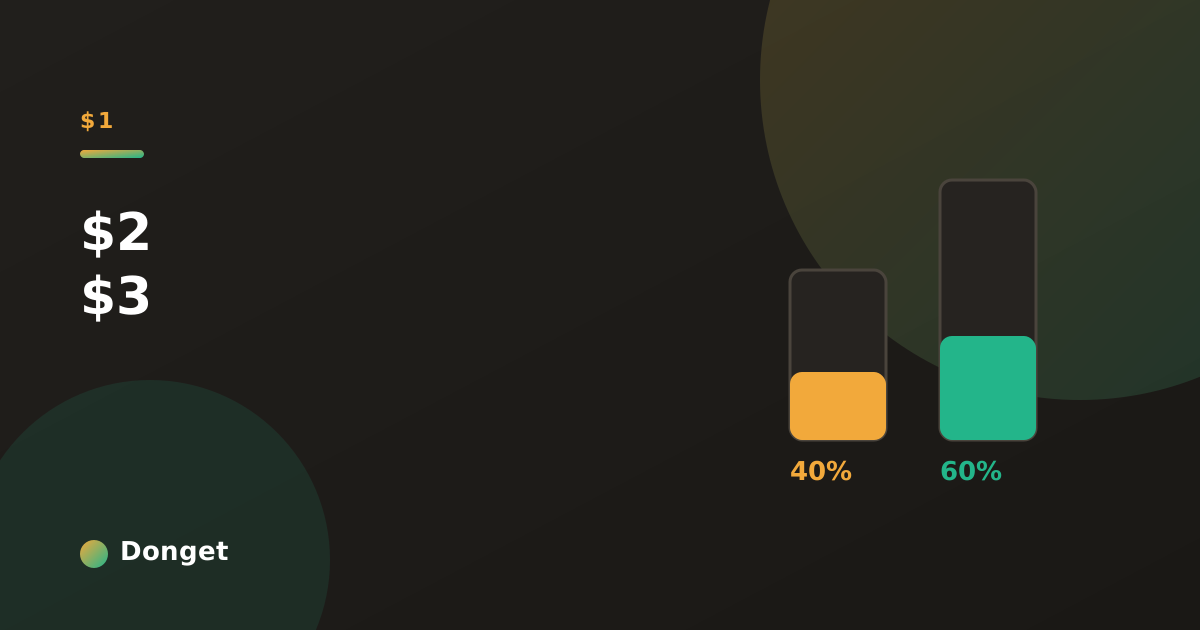
| Share of the €6,000 total | 40% | 60% |
| Of €1,800 shared costs | €720 | €1,080 |
| Left after shared costs | €1,680 | €2,520 |
Compared with €900 each, A pays €180 less and B pays €180 more, and what each has left is now in the same ratio as what each earns. Neither person is being subsidised: they are contributing the same proportion.
Use net income, not gross — gross is a number neither of you ever sees. Use a stable figure for variable pay: a twelve-month average, revisited yearly, beats renegotiating every commission cheque.
Method 2 — split by what is actually left
Share of income treats both people’s obligations as identical, and often they are not. One of you may be repaying a student loan, supporting a parent, or paying €200 a month to get to a job the other walks to. The residual method subtracts those first.
Say A has €400 a month of unavoidable personal costs and B has €200:
| Person A | Person B | |
|---|---|---|
| Net income | €2,400 | €3,600 |
| Unavoidable personal costs | €400 | €200 |
| Available | €2,000 | €3,400 |
| Share of the €5,400 available | 37.0% | 63.0% |
| Of €1,800 shared costs | €666.67 | €1,133.33 |
It is fairer and it is more work, because “unavoidable” now has to be defined by two people who may disagree about a car. Keep the list short and boring — debt, dependants, getting to work — and it stays workable. Put a gym membership on it and you have invented a monthly argument.
What stays equal
Proportional splitting is for costs that arrive whether or not anyone had a good month: rent, utilities, groceries, insurance, the shared phone plan. It is not a general theory of money.
Discretionary spending you each chose is a different category and usually stays even. The tasting menu one of you booked, the birthday present you are giving jointly, the extras on a trip — splitting those equally keeps the proportional rule aimed where it belongs. Households that apply percentages to absolutely everything tend to abandon the whole system within a couple of months.
Two things to settle before you start, because they cause more trouble than the maths. Contribution is not ownership — if one person pays 60% of the sofa, decide separately whether they own 60% of it, rather than discovering the assumption during an argument. And the percentages are not a scoreboard. They exist so the subject can stop coming up.
Where Donget comes in
Both methods are a fixed ratio applied to a recurring set of costs, which is exactly what the split modes are for. Add the rent under Add expense, choose Percentage, and enter 40 and 60 — or Multiplier if you would rather think in shares than percentages, which is easier when three people are involved. Every later expense keeps that split without anyone recalculating.
The Balances tab then shows what is actually true at the end of the month rather than what should be true: who fronted more than their share, and by how much. One Settle up clears it in the fewest transfers, so a proportional household is not making four small payments a week. If the percentages need to change, you change them on the next expense — the history stays as it was.
Two related reads if this is the live question: when one of you pays for everything, and moving in together, which is usually when the subject comes up first.
Frequently asked questions
Should couples with different incomes split bills 50/50?
Equal splitting divides the amount, not the effort. When one income is much larger, the same figure is a small dent for one person and most of the month for the other, which is why many households switch to a proportional share for fixed costs.
How do you calculate a proportional split?
Add both net incomes, divide each person’s income by that total, and apply the resulting percentages to the shared costs. Two incomes of 2,400 and 3,600 give 40% and 60%.
What is the residual income method?
Subtract each person’s unavoidable personal costs — a loan, a commute, support payments — before working out the percentages, so the split reflects what each person actually has available.
Does proportional splitting mean one person owns more of what we buy?
No, and it is worth saying out loud before you start. Contribution and ownership are separate questions; decide the second one explicitly rather than letting the percentages imply an answer.
Which costs should stay 50/50?
Discretionary things you each chose — a restaurant, a gift you both wanted to give, a trip’s extras. Proportional splitting is aimed at the fixed costs that arrive whether or not anyone had a good month.
How often should we recalculate the percentages?
When an income changes materially, and otherwise once a year. Recalculating monthly turns a household agreement into an audit.
The bottom line
Pick share-of-income if you want something you can compute in ten seconds, residual if the two of you carry very different fixed obligations. Apply it to the bills that arrive on their own, leave the fun money even, and write the percentages down where you can both see them.
Download Donget free and let the percentage do the arithmetic every month instead of the two of you.