Travel kitty or split as you go? Handling group money on a trip
A travel kitty is a shared pot everyone pays into for small daily costs; splitting as you go logs each cost and settles at the end. Most groups do best with both. Here is how to run each fairly.
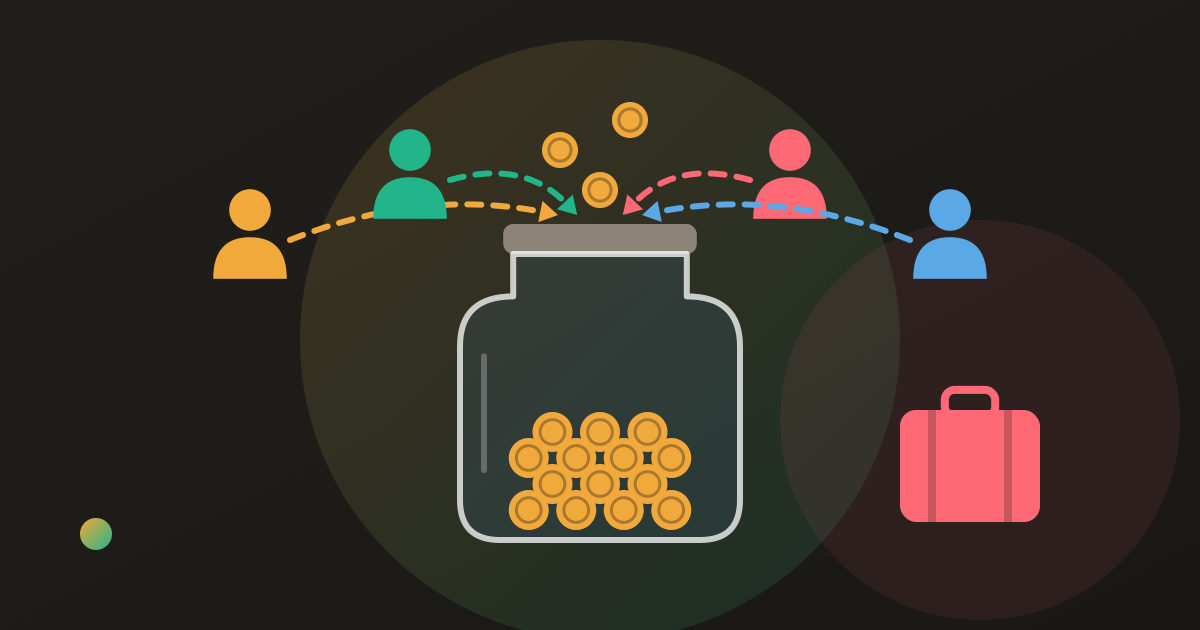
Four of you are going away for the weekend, and someone in the group chat suggests a travel kitty: everyone puts in €100 on the first morning, one person holds it, and you stop splitting every coffee. Someone else would rather pay as you go and sort it out at the end. Both sound reasonable, and both can go wrong in ways that only show up on the last day.
A travel kitty — a pot everyone pays into and one person spends from — suits the small, constant, shared costs of a trip. Splitting as you go suits big or uneven ones. Most groups do best with both: a kitty for the daily small stuff, a log of the big costs, and one settle-up at the end.
What a travel kitty is
A travel kitty is a shared pot of money that everyone contributes to at the start of a trip. One person holds it, in cash or on their own card, and pays shared costs from it: groceries, taxis, the bill for a lunch everyone ate. When it runs low, everyone tops it up by the same amount. Whatever is left at the end goes back to the people it belongs to.
The idea is simple: instead of tracking dozens of small debts, you track a handful of contributions.
Where a kitty works
Lots of small, equal costs. A round of drinks, a bag of groceries, a shared taxi. Logging each of these separately is tedious, and in a kitty nobody has to.
Cash-heavy places. Markets, small restaurants and tips that only take cash. One person paying from a shared wallet is faster than four people counting coins at a till.
Fewer debts between people. Nobody fronts money for anyone else on the small stuff, so nobody ends the day owed €4.50 by three different people.
Where a kitty goes wrong
Uneven use. The kitty pays for a kayak tour that one person skips, or the drinks of the two who stayed out late. Paid from a common pot, those costs quietly land on everyone.
Someone has to hold it. The holder carries the group’s money, pays for everything and gets asked “how much is left?” at every meal.
Top-ups drift. When the pot runs dry, someone covers the next bill “until we top up”, and that becomes a debt the kitty was meant to avoid.
The leftover. At the end there is cash in the holder’s wallet, and splitting it equally is only right if everyone used the kitty equally.
None of these is fatal. They just mean the kitty needs a record, not only a wallet.
Splitting as you go
The alternative is no pot at all. Whoever pays for something records it, with the people it was for, and the group settles once at the end in the fewest possible transfers. It handles uneven costs naturally — the kayak tour is split among the three who went — and big bookings fit in without anyone collecting money in advance. The fair way to split a group trip sets out the rules that make this work.
Its weakness is the mirror image of the kitty’s strength: a day of small purchases means a day of small entries, and somebody has to make them.
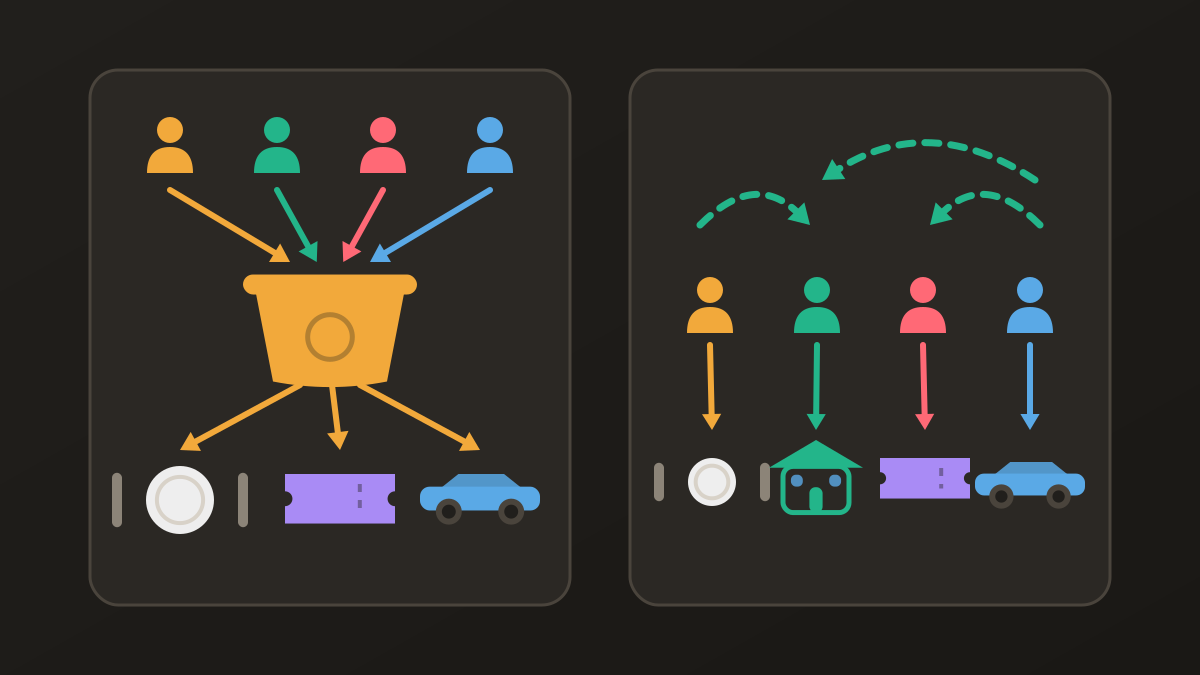
The hybrid: a kitty for small costs, a log for big ones
Most groups end up here. The kitty covers the small daily costs that everyone shares equally. Big costs — the accommodation, the car hire, the long dinner on the last night — are paid by whoever books them and logged with the people they were for. Splitting an Airbnb with friends and splitting fuel on a road trip cover two of those in detail.
How to run a group trip money pool fairly
Three habits make a kitty fair, whether or not you use an app:
- Record every contribution against the person who paid it, including top-ups.
- Record what the kitty paid for and who it was for. “Kayak, three people” is the line that protects the person who stayed on the beach.
- Settle the leftover by use, not equally. Each person’s unused contribution is what they put in minus their share of what the kitty spent.
A worked example: a weekend with a €400 kitty
Ines, Marco, Lena and Sam put €100 each into a travel kitty that Ines holds: €400. From it she pays groceries (€96), taxis (€64) and a lunch (€120) for all four, and a kayak tour (€90) for the three who went — Sam skipped it. The kitty spends €370, leaving €30.
Each person’s share of the kitty spending is €24 + €16 + €30 = €70 for the shared items, plus €30 for the kayak for Ines, Marco and Lena. So Ines, Marco and Lena each used exactly €100 of the kitty; Sam used €70. The €30 left over is all Sam’s, not €7.50 each.
Two big costs sit outside the kitty: Marco paid €480 for the apartment and Lena €200 for the last dinner, both for all four — €120 and €50 a head.
| Ines | Marco | Lena | Sam | |
|---|---|---|---|---|
| Put into the kitty | €100 | €100 | €100 | €100 |
| Share of kitty spending | €100 | €100 | €100 | €70 |
| Paid big costs | — | €480 | €200 | — |
| Share of big costs | €170 | €170 | €170 | €170 |
| Holding kitty cash | €30 | — | — | — |
| Balance | −€200 | +€310 | +€30 | −€140 |
Each balance is what the person put in or paid, minus their shares, minus any kitty cash they are still holding. Ines’s −€200 is her €170 share of the big costs plus the €30 of Sam’s money still in her wallet. The balances add to zero: −200 + 310 + 30 − 140 = 0.
Settled in the fewest transfers, that is three: Ines pays Marco €200, Sam pays Marco €110 and Sam pays Lena €30. The leftover never needs its own transfer; Ines’s €200 includes it, and Sam’s debt is €30 smaller because of it. With four balances and no smaller group that cancels out on its own, three is the minimum — how debt simplification works explains why.
Where Donget comes in
Donget does not hold or move money; the kitty stays in Ines’s wallet or on her card. What it holds is the record. Each contribution goes in with Record a transfer: Marco as Payer, Ines as Received by, €100 as the Amount — and the same for Lena and Sam. Ines’s own €100 needs no entry, since it never leaves her. Each kitty purchase goes in with Add expense, Paid by Ines, split Equal among the people it was for, with Sam left out of the kayak. Marco’s apartment and Lena’s dinner go in the same way with their own names as the payer.
Settle up then suggests three transfers, like those above, and Paid records each one when it happens. Expenses can be added offline and sync when you are back online, which matters on a trip — offline expense-splitting apps covers what that means in practice. There is no export and no automatic reminder; the group’s balance is the record, and anyone in the group can open it. If you are still choosing a tool, see the apps for splitting travel expenses.
Frequently asked questions
What is a travel kitty?
A shared pot of money everyone on a trip pays into. One person holds it and pays shared costs from it, and whatever is left goes back to the people it belongs to.
How much should everyone put into a travel kitty?
Estimate the small shared costs per day, multiply by the days, and divide by the people. Start a little low and top up; one top-up is less work than returning a large leftover.
Who should hold the travel kitty?
Someone organised who will be at most of the shared moments, ideally not the person who booked the accommodation. Rotating the role each day also works.
What happens to the money left in the kitty at the end of the trip?
It goes back to whoever used less of it, not equally to everyone. Each person’s share of what the kitty spent shows exactly whose it is.
How do you collect money for a group trip before you go?
For bookings, the person who pays records it and everyone owes them their share. For a cash kitty, everyone hands over their contribution on day one, written down against their name.
Is a shared travel fund better than splitting as you go?
Neither is better everywhere. A fund suits many small, equal costs; splitting as you go suits big or uneven ones. Most groups do best with both.
Can a splitting app hold the kitty money?
Donget does not. It records the contributions, what the kitty paid for and who each cost was for, and works out who owes whom; the money stays with the holder.
The bottom line
A travel kitty saves you from logging every coffee, and splitting as you go keeps uneven costs fair. Use the kitty for small shared costs, log the big ones, record who put in what and who each cost was for, and the leftover sorts itself out in the final settle-up.
Download Donget free and keep the kitty, the big bookings and the final settle-up in one group your whole trip can see.