How couples split travel costs (without keeping score)
How do couples split travel expenses? Pick one rule before you book: 50/50, by income, one pays flights and the other the stay, or a shared trip pot. Then log the big costs and settle once, after you are home.
The flights are open in one tab and the hotel in another, and one of you is about to pay for both “for now”. Or you are already back, and one card carried most of the trip while the other quietly wonders what they owe. How do couples split travel expenses without turning a holiday into a ledger?
Pick one rule before anything is booked: 50/50 if your incomes are close, in proportion to income if they are not, one pays flights and the other the stay if the totals come out near your target, or a shared pot for daily costs. Log only the big items, and settle once, after you are home.
Why trips are harder than monthly bills
Rent and groceries arrive on a schedule, so most couples settle into a rule for them. A trip is different. The biggest costs land months before you leave, on whichever card was open at the time. Abroad, a dozen small payments a day come from whoever is nearest the till. And a holiday is the one shared cost where your choices diverge most: one of you wants the nicer hotel, the other would have been happy with the cheaper one.
If you already have a rule for the household, a trip can use it. If you don’t, whether to split bills 50/50 is the place to start; here the question is narrower: what to do with this one trip.
The four ways couples split vacation costs
1. Straight 50/50. Every shared cost is halved. It is simple and needs no salaries on the table, and it suits couples whose incomes are close. It breaks when one partner earns clearly more and also chooses the hotel: the other pays half of a holiday priced for someone else’s budget.
2. In proportion to income. Each pays their share of your combined take-home pay. If one of you brings home $5,000 a month and the other $3,000, that is five eighths and three eighths. The trip then costs each of you the same fraction of your pay. The method itself is set out in how to split bills when you earn different amounts.
3. One pays flights, the other pays the stay. Each partner takes a whole category, so nobody owes anyone anything. It feels light, and it works when the two totals land near the split you wanted. Flights and accommodation rarely cost the same, though, so add them up before you call it even.
4. A shared trip pot. You both pay into one pot (a joint card, or cash one person carries) and the daily costs come out of it. Pay in by your agreed ratio: for a $600 pot at five eighths and three eighths, that is $375 and $225. It is the most relaxed option on the ground, and a travel kitty versus splitting as you go covers how to run one and what to do with the leftover.
How couples split travel expenses: choosing the rule
Three questions settle it for most couples.
Are your incomes close? If yes, 50/50 is usually fine and nobody needs to compare payslips. If one income is clearly larger, keep reading.
Who is choosing the level of the trip? If the higher earner picks the destination, the hotel and the restaurants, a proportional split, or that partner paying the difference for the upgrade they wanted, keeps the holiday from costing the other person a month’s savings.
How much tracking can you both stand? If neither of you wants to log anything abroad, use categories (flights against the stay) for the big items and a pot for the small ones, and check the totals once at the end.
A mix is fine: proportional for the stay and the flights, 50/50 for food. Just agree which bucket each cost belongs to before you go, because “that dinner was your idea” is a bad conversation to have on a terrace.
A worked example: the same trip, two rules
Nina takes home $5,000 a month and Theo $3,000. They spend a week away, and the shared costs come to $3,720:
| Cost | Amount | Paid by |
|---|---|---|
| Flights | $1,080 | Theo |
| Hotel, six nights | $1,500 | Nina |
| Car hire | $300 | Theo |
| Meals and day costs | $480 | Nina |
| Meals and day costs | $360 | Theo |
| Total | $3,720 | Nina $1,980, Theo $1,740 |
Theo’s dive trip ($150) was his own idea and his own cost, so it stays off the list.
Split 50/50, each owes $1,860. Nina paid $1,980, so she is $120 ahead: Theo pays Nina $120. The holiday costs Nina 37.2% of one month’s take-home pay and Theo 62.0%.
Split by income (five eighths and three eighths), Nina’s share is $2,325 and Theo’s $1,395. Nina paid $1,980, so she is $345 short: Nina pays Theo $345. The holiday now costs each of them exactly 46.5% of a month’s pay.
Notice that the transfer changes direction, not just size. Under 50/50 Theo owes Nina; split by income, Nina owes Theo. That is why “we’ll sort it out later” goes wrong when you never agreed which “it” you meant.
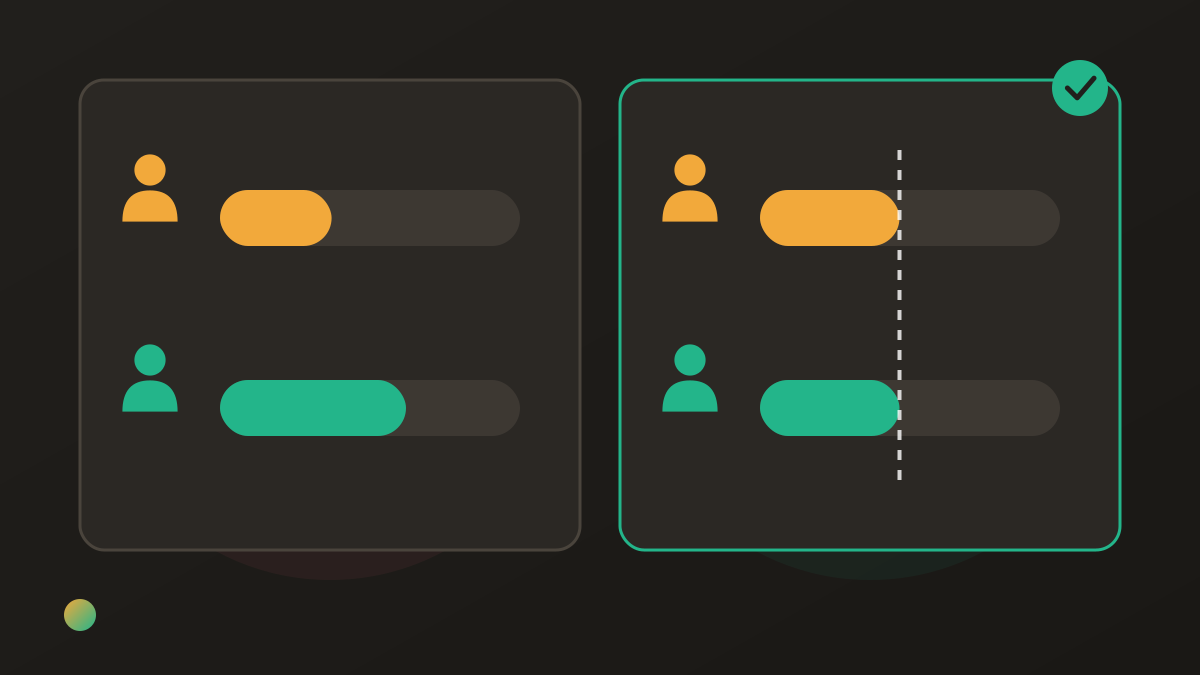
The flights-against-the-stay trade on its own would have put Theo at $1,080 and Nina at $1,500, about 42% and 58%. That is neither 50/50 nor five eighths, which is why the category method needs a quick sum at the end even when it feels balanced.
How not to turn a holiday into accounting
Log the big items when they happen. Flights, the stay, car hire, tours, the expensive dinner. Five or six entries cover most of a trip’s money.
Let the small stuff be small. Coffees, snacks and bus tickets either come out of the pot or get split roughly by taking turns. Over a week, turns even out far better than people expect.
Keep solo extras solo. The spa day, the dive, the shopping. Whoever wanted it pays for it, or the other pays as a gift and says so.
Settle once, after you are home. One transfer, on a quiet evening, once the last card payment has cleared. Settling at the airport, tired and sunburnt, is when the arguments start.
If one of you ends up paying for most trips without either of you deciding it, that is a pattern rather than a holiday question, and when one partner pays for everything is about exactly that.
Where Donget comes in
A group for the two of you holds the record so neither of you has to remember it. Each big cost goes in with Add expense, Paid by whoever paid, split Equally for 50/50 or by Shares with 5 and 3 for Nina and Theo’s income split. A mixed rule is just different settings on different expenses. Costs paid abroad can be entered in the local currency, and expenses added offline sync when you are back online.
Balances shows who is ahead as you go, and Settle up turns it into one transfer, $345 from Nina to Theo in the example; Paid records it once it is done. Donget does not move money; you pay each other your usual way. It is free, with no ads and no daily cap on entries. The wider guide to expense splitting for couples covers the everyday costs between trips.
Frequently asked questions
How do couples split travel expenses?
Most use one of four rules: 50/50, in proportion to income, one pays flights and the other the stay, or a shared pot. Agree the rule before booking and settle once, after the trip.
Who pays for vacation in a relationship?
There is no default. Similar incomes usually split equally; when one earns clearly more, a split by income or that partner covering the upgrade they chose is common. Say it before the booking.
Should the partner who earns more pay more for holidays?
Often, yes, especially when they choose the level of the trip. Splitting by income means each of you spends the same fraction of your pay on it.
Is it fair if one of us pays the flights and the other pays the hotel?
It is fair when the totals land close to the split you wanted. Add them up first; one transfer at the end closes any gap.
How do we split vacation costs with a partner without tracking every coffee?
Log only the big items, handle daily costs with a small pot or by taking turns, and settle the difference once, after you are home.
What about things only one of us wanted, like a spa day or a dive?
Leave them off the shared list. Whoever wanted it pays, or the other pays as a gift, said out loud.
The bottom line
Couples rarely fall out over the price of a holiday; they fall out over an assumption nobody said aloud. Choose 50/50 or a split by income before you book, use categories or a pot to keep the small stuff light, log the big costs as they happen and settle once, at home, in a single transfer.
Download Donget free and keep your trip’s big costs in one place you can both see, then settle up in one transfer when you are home.