A friend dropped out of the trip: who covers their share?
If a friend dropped out of a trip, separate confirmed refunds, committed shared bookings and avoidable future costs. Then agree the revised shares together.

The house is booked, activity tickets are paid for and the shopping list is nearly finished. Then Leo messages: the trip is no longer possible. Everyone wants to be kind, but “we’ll sort it out” leaves Maya wondering whether the house payment is now a cost for three people or four.
If a friend drops out of a trip, separate confirmed recoveries, shared bookings that still cost money and future spending you can avoid. Check what the group agreed before booking, then discuss the remaining allocation together. Record the revised costs and actual payers without treating the calculation as proof of what anyone is legally required to pay.
When a friend drops out, start with the costs
Changing the headcount on every entry at once can give the wrong result. A fixed-price house, a returned activity ticket and groceries nobody has bought are three different situations. They do not all become “divide by three”.
Make a short inventory of each purchase, its payer, what has been returned and what is still uncertain. Keep the confirmations alongside your own record. A possible refund is not money in someone’s account yet; leave the result provisional until you know what happened.
If the group has not booked anything, it can simply revise the plans for the people still going. Planning a group trip starts those decisions before anyone fronts a payment.
Keep recovered, committed and future spending separate
Recovered money reduces a cost that somebody already paid. Identify who received it. If Priya paid for tickets and receives a refund, Priya’s net outlay falls; the other friends have not each received that money directly.
Committed shared bookings still cost the group something after any confirmed recovery. The original headcount explains the earlier agreement, but it does not by itself settle a new disagreement. Talk about keeping that allocation, sharing the cost differently or finding a replacement.
Avoidable future spending has not happened yet. Buy less food, revise a booking request or drop an optional activity from your plan where you can. Do not create an expense for a shopping estimate that nobody actually spent.
A shared accommodation split also depends on who the cost covers. Here, the extra question is which of those costs remain after the plans change.
What did everyone agree before booking?
Look for the actual conversation, not what one person remembers as obvious. Did everyone approve the amount? Did you discuss what would happen if someone could not go? Was the plan to hold a place until a replacement came along?
An earlier agreement is a useful starting point for a voluntary conversation. It is not a reason for an expense app to declare the discussion finished. If nothing was agreed, present the remaining cost and several proposals instead of naming a debt first.
You can say: “The house still costs the same, the ticket money has come back, and we can reduce the food shop. Shall we keep the house split we agreed, or do we want to change it?” Give people space to respond without asking them to justify the personal reason for cancelling.
A worked example: one cancellation, three kinds of cost
Maya, Tom, Priya and Leo planned a weekend. They had all agreed that the €960 house cost would remain shared four ways if someone dropped out, unless a replacement covered that place. In this hypothetical case, Leo cancels, nobody replaces Leo, and all four confirm they still accept that allocation. This is their choice, not a rule for every trip.
Maya has paid €960 for the house, with no money recovered from that booking in this example. Priya paid €240 for four activity tickets and has now received a confirmed €60 refund for Leo’s ticket. The remaining three tickets cost €180. Tom then buys €180 of groceries for the three attending, rather than the €240 originally planned for four. No payments between friends have happened yet.
| Cost kept in the record | Net paid by | Maya | Tom | Priya | Leo | Total |
|---|---|---|---|---|---|---|
| House | Maya | €240 | €240 | €240 | €240 | €960 |
| Three activity tickets, after refund | Priya | €60 | €60 | €60 | €0 | €180 |
| Groceries actually bought | Tom | €60 | €60 | €60 | €0 | €180 |
| Share | €360 | €360 | €360 | €240 | €1,320 |
Net paid amounts are Maya €960, Tom €180, Priya €180 and Leo €0. Subtract their shares: the balances are Maya +€600, Tom −€180, Priya −€180 and Leo −€240. They add to zero.
Tom pays Maya €180, Priya pays Maya €180 and Leo pays Maya €240. Three transfers clear the three amounts due, which is the minimum. Priya does not also distribute the €60 refund: it has already reduced Priya’s paid amount and the ticket cost from €240 to €180.
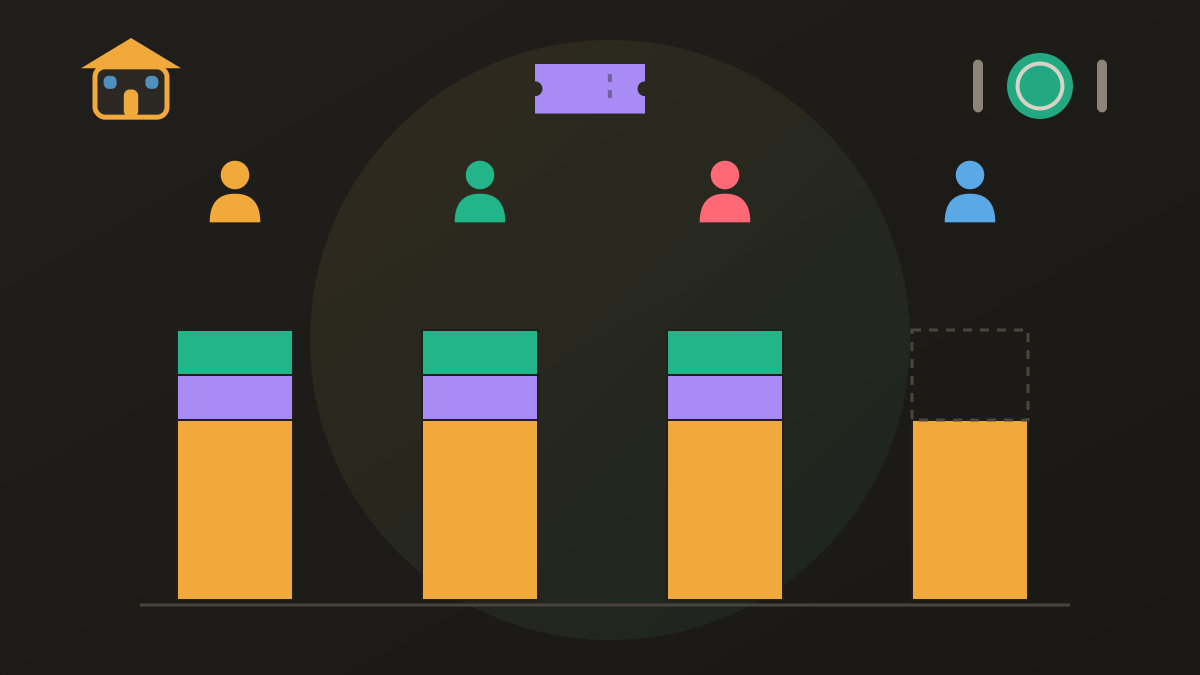
The final shared cost is €960 + €180 + €180 = €1,320. That reflects €60 returned on tickets and €60 of planned groceries never purchased. The unused grocery budget is not a second refund.
If the group chooses a different outcome
The same spending can support a different agreement. If everyone decides to absorb Leo’s €240 house share equally among the three attending, each takes another €80. Maya, Tom and Priya then have €440 shares and Leo €0. Maya is owed €520; Tom and Priya each pay Maya €260.
That changes the allocation, not the €1,320 total or the amounts each person originally paid. Do not quietly switch between this result and the first one: confirm which proposal everyone accepts.
If a replacement comes, agree which bookings their contribution covers and count it once. If costs remain uncertain, keep the settlement provisional. The wider group-trip sharing rules help distinguish a shared purchase from someone’s own optional activity.
Where Donget comes in
In Donget, keep the house expense split Equally among the four only if that is the confirmed agreement. Once Priya has actually received the refund, edit the ticket expense to the remaining €180 and include only Maya, Tom and Priya. Add Tom’s actual €180 grocery purchase for those same three. Keep the original purchase and refund confirmations separately; do not add the refund as another positive shared expense.
Settle up works from those recorded costs and payments. The who-owes-whom calculation explains why the transfers follow the net balances. People pay through their usual method, then Paid records each completed payment. Donget does not handle supplier refunds, cancel bookings or decide cancellation shares. It records what the group has agreed.
Frequently asked questions
Who pays if someone cancels a group trip?
First check what money has actually been recovered, what shared spending remains and what future purchases can be avoided. Then agree how to allocate the remaining costs, using any earlier group agreement as the starting point; the arithmetic does not establish a legal obligation.
Should a friend who drops out still pay for the accommodation?
That depends on what the group voluntarily agreed and what costs remain after any confirmed recovery. Keeping the original allocation, finding a replacement or sharing the remaining cost among those going are different proposals to discuss, not automatic outcomes.
How do we split an Airbnb cancellation among friends?
Confirm the actual booking outcome before calculating the group’s shares. Deduct any money that has really been returned, identify who received it, and discuss how the remaining cost will be shared; an estimated refund is not recovered money.
Should someone who cancels pay for food they will not eat?
For food that has not been bought, revise the shopping plan for the people attending. Already bought shared food is a separate cost to discuss, including whether it can be returned or used by someone else.
What if another friend takes the cancelled place?
Agree which costs the replacement will cover before they join the spending plan. Apply that contribution once, so the same place is not charged in full to both the departing friend and the replacement.
Can Donget decide cancellation shares or issue refunds?
No. The group agrees the shares and handles any supplier refund separately. Donget can record the resulting expenses and payments, but it does not cancel bookings, decide entitlements or move money.
The bottom line
Reconcile the spending before changing the split. Confirm money recovered, remove purchases that never happened, and agree who shares the remaining costs. Keep both the actual payer and the chosen allocation visible, so an act of generosity or a retained share is an explicit decision.
Download Donget free and keep the revised trip costs and agreed shares in one record.