Birthday party checklist for adults: jobs and shared costs
Plan an adult birthday party with named jobs, clear handoffs and an agreed budget. Copy the checklist, keep gifts separate and settle shared purchases once.
The room is booked, someone has offered to bring a cake, and three friends have said “happy to help”. Nobody has checked who will collect the food or who is staying to clear up. The party has volunteers, but it does not yet have a plan.
Build an adult birthday party checklist around the decisions, the people doing the work and the agreed spending. Give each job an owner and a clear handoff, say which costs guests are sharing before they commit, and keep presents separate unless everyone has agreed otherwise.
Choose the party and the contribution model
Start with what the birthday person actually wants: a small meal, a games evening, dancing or something else. Confirm the guest list, place and rough timing before buying decorations for an event nobody has chosen.
Then agree whether someone is hosting as a treat, guests are bringing food, or the group is sharing named purchases. These are different invitations. “We’re organising it” does not tell a guest whether they should expect a later bill.
Ask about food preferences, access and the sort of evening people can join comfortably. Give guests a way to suggest a smaller plan privately. A modest party with clear arrangements is easier to answer than an unspecified invitation to spend.
Make a birthday party checklist people can use
Copy this table into the note or document your group already uses. Replace each dash with a person or a decision. The timing column is part of your written plan, not a promise of task dates in an app.
| Job or decision | Named owner | Finished when | Timing or handoff |
|---|---|---|---|
| Confirm place and guest list | — | The group knows where and who | Before purchases |
| Send invitation and cost arrangement | — | Guests can accept the actual plan | Before commitments |
| Coordinate food and preferences | — | Buyers know the list and agreed limit | Before shopping |
| Collect cake | — | Cake reaches the person receiving it | Agree collection separately |
| Prepare room and music | — | The space is ready for guests | Agree access with host |
| Clear food and borrowed equipment | — | Each item has a destination | Before people leave |
| Share actual costs and repayments | — | Buyers and participants have checked the record | After receipts are available |
Add only jobs this party needs. A who brings what list is useful when several guests are bringing food; a party with one agreed shop needs buyers rather than six competing shopping lists.
Give each job an owner and a handoff
“Someone collect the cake” remains an unassigned job. “Sam collects the cake and hands it to Rosa at the venue” names both the responsible person and the point where responsibility passes on.
Ask people to accept jobs rather than allocating their evening without checking. If someone cannot do a task, reopen that job and find another owner. Do not silently assume the host will pick it up.
Setup and cleanup deserve the same treatment as the visible jobs. Agree who takes borrowed equipment home and who deals with leftover food. Those contributions matter without needing an invented hourly price or an automatic discount on the shopping.
Send the invitation with the cost arrangement
For a shared-shopping party, a message could say: “We’re sharing food and soft drinks for five, up to €200 altogether, so at most €40 each. Please check with Jules before adding anything to the shop.”
That is an example budget, not a standard party price. Choose a limit your own group accepts. Say who approves a change, and ask again if the headcount or plan changes materially.
A restaurant celebration needs its own wording about the birthday person’s meal. The birthday dinner guide covers that situation. Hosting a party does not, by itself, establish that everyone is treating or being treated.
Keep the cake and presents separate from shared shopping
A cake can be part of the common shopping, a host’s treat or a gift from some friends. Name which one it is. The person collecting it is not automatically the person who should bear its whole cost.
Keep a group present separate unless contributors explicitly agree to combine the funds. Bringing a personal gift does not automatically reduce a guest’s food share, and a gift should not be added to the shopping total a second time.
If the party uses potluck contributions instead, agree which extras still need reimbursement. The house party cost guide explains how to distinguish a volunteered dish from a purchase made for the group.
A worked example: five adults and a cake gift
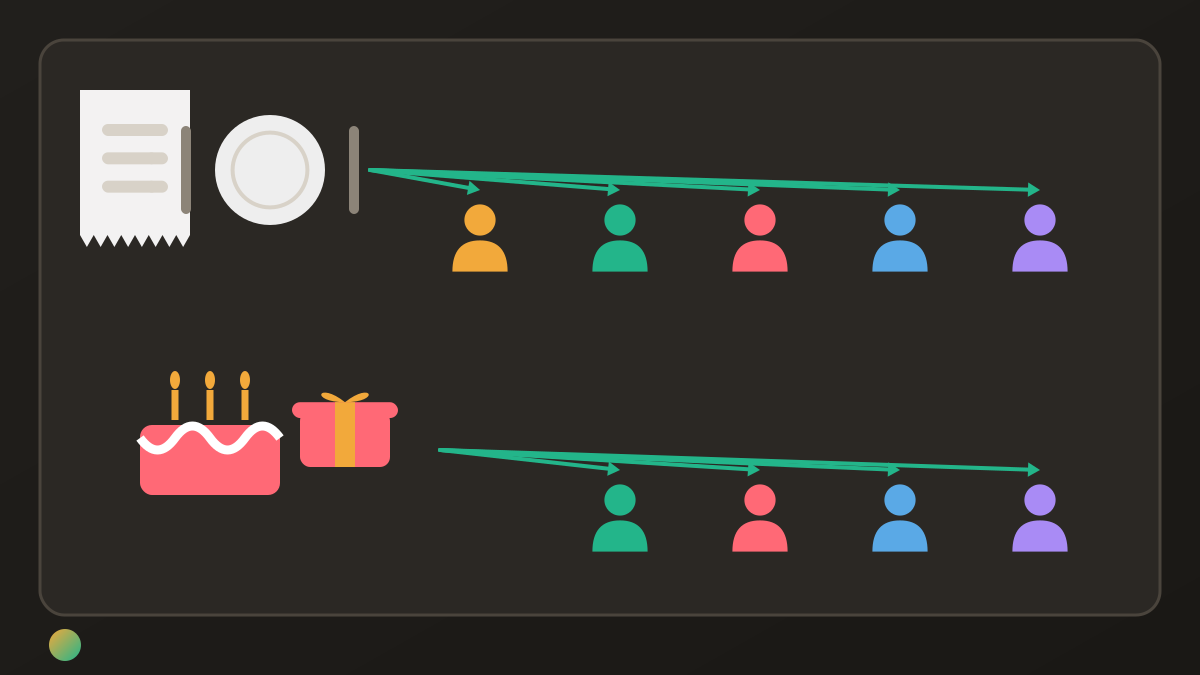
Noor is celebrating with Jules, Rosa, Sam and Theo. All five agree to share food and soft drinks equally. Separately, the four friends agree to give Noor a cake, sharing its cost between themselves.
Jules pays €160 for food, Rosa pays €40 for soft drinks, and Sam pays €40 for the cake. There are no other shared purchases in this hypothetical example.
| Purchase | Paid by | People sharing it | Each person’s share |
|---|---|---|---|
| Food, €160 | Jules | All five | €32 |
| Soft drinks, €40 | Rosa | All five | €8 |
| Cake, €40 | Sam | Jules, Rosa, Sam and Theo | €10 |
Noor’s share is €40. Each of the four friends has a €40 refreshments share plus €10 for the cake, making €50. The shares total €240, exactly the amount paid.
| Person | Paid | Agreed share | Paid minus share |
|---|---|---|---|
| Noor | €0 | €40 | −€40 |
| Jules | €160 | €50 | +€110 |
| Rosa | €40 | €50 | −€10 |
| Sam | €40 | €50 | −€10 |
| Theo | €0 | €50 | −€50 |
| Total | €240 | €240 | €0 |
Noor pays Jules €40, Rosa pays Jules €10, Sam pays Jules €10, and Theo pays Jules €50. Jules receives €110. Four payments are the minimum here because each of the four people with an unpaid balance must make a payment. Buying the cake did not exempt Sam from the rest of the agreed costs.
Confirm changes and finish the cleanup handoff
Before guests arrive, check the few remaining gaps: who receives deliveries, who has the borrowed items and who is still available afterwards. A named owner can ask for help; they should not discover that “owner” meant doing everything alone.
Ask before making an extra shared purchase. If the shop costs less than the agreed limit, use the actual lower amount. Afterwards, share receipts and account for repayments already received before requesting money again.
Keep jobs and actual expenses together in Donget
In the group’s Tasks, use Add task → Who takes it? to assign “Cake collection” to Sam. After Mark as done, Spent money on Cake collection? → Add expense opens a form with that title only. Sam must enter €40, check the payer, select the four cake contributors and choose Equally before saving.
Completing the job alone creates no expense. Record the food and soft drinks once each, with all five participants. Use Settle up for the repayments and Paid only after money has moved through your usual payment method; Donget does not move it. Coordinate timing separately: tasks do not have dates, quantity fields or automatic reminders.
Frequently asked questions
What should an adult birthday party checklist include?
Include the place, guest list, invitation, contribution model, food, cake, setup, cleanup and final costs. Give each relevant job a named owner and a clear handoff rather than assuming the host will cover every gap.
How far ahead should you plan a birthday party?
Work backwards from the arrangements your party actually needs. Confirm people and any booking before purchases, then agree shopping and collection handoffs. There is no single lead time that suits a small gathering and an event needing a venue.
Who should pay for an adult birthday party?
Choose the arrangement before guests commit: someone can treat, guests can bring agreed contributions, or the group can share named purchases. A birthday invitation alone does not establish which arrangement applies.
Does bringing a present reduce my share of the party costs?
Only if the people sharing the costs agreed that beforehand. Keep a personal gift, a joint present and shared refreshments separate so the same contribution is not counted twice or silently treated as a discount.
How do you divide setup and cleanup jobs?
Ask people to accept specific jobs, name who is responsible and describe the handoff. Include clearing food and returning borrowed equipment, and confirm who remains available after the party.
Can completing a party task automatically create an expense?
No. In Donget, the follow-up Add expense action can open a form with the task title only. The buyer still enters the amount and checks the payer, participants and split before saving.
Keep the plan small enough to use
A useful checklist tells people what they have accepted, who they can hand over to and which spending they agreed to share. Check those points before the party, then let the evening be a celebration.
Download Donget free and keep the agreed party jobs, purchases and repayments together.