Road trip checklist for a car full of friends
A road trip checklist for friends: car checks, documents, packing, the drive itself and the money rules to agree before you leave, with whose car and who drives handed out as tasks.
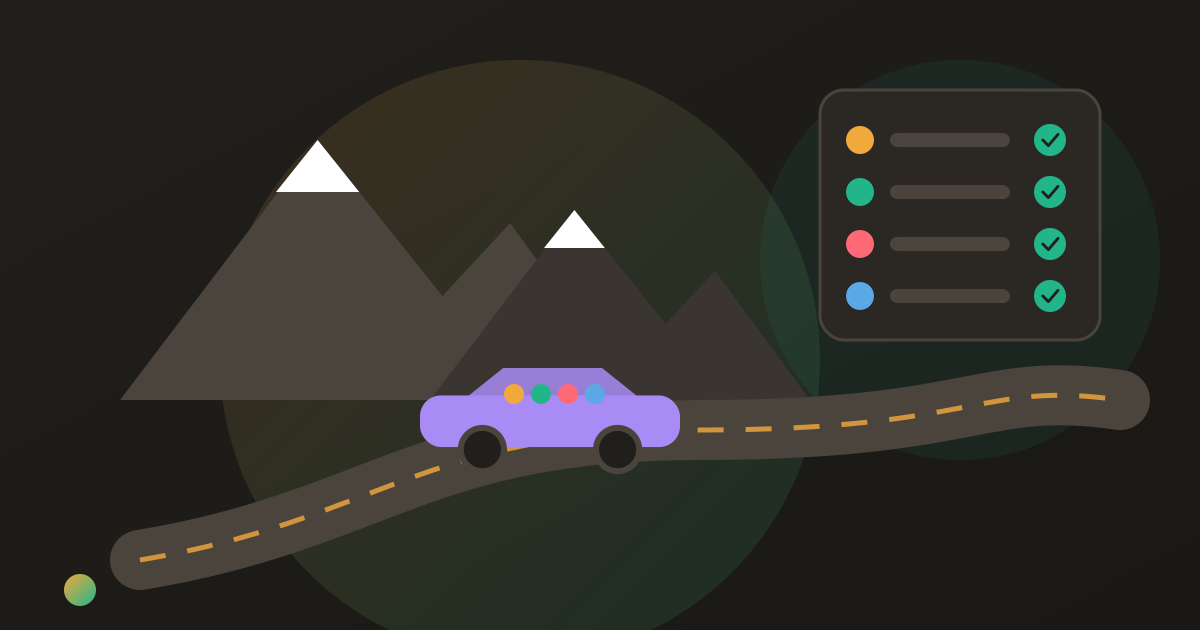
Four friends, one car, a long weekend. The playlist is sorted and the snacks are in a bag, but nobody has checked the spare tyre, two people assume the other is driving the first stretch, and the question of who pays for fuel will come up at the first fuel stop whether you planned for it or not.
A road trip with friends goes wrong in small, predictable ways, and almost all of them are fixed by twenty minutes of talking before you leave. A good road trip checklist covers five things: the car, the documents, the packing, the drive itself, and the money rules. The jobs on it — whose car, who drives, who books — are tasks someone takes; fuel, tolls and parking are expenses you split at the end.
Tasks and expenses: the two halves of the list
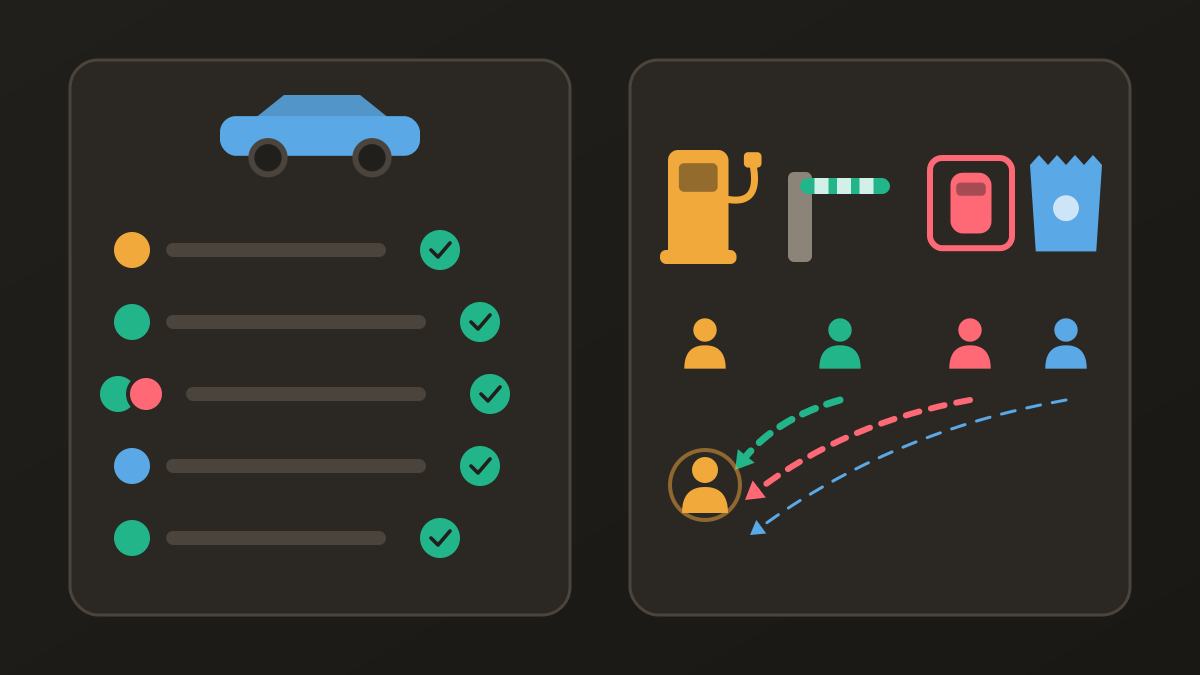
Every item on a road trip checklist is one of two kinds. Some are work: bringing the car, driving the night stretch, booking the stay, packing the first-aid kit. Others are money: the tank of fuel, the toll booth, the car park at the beach.
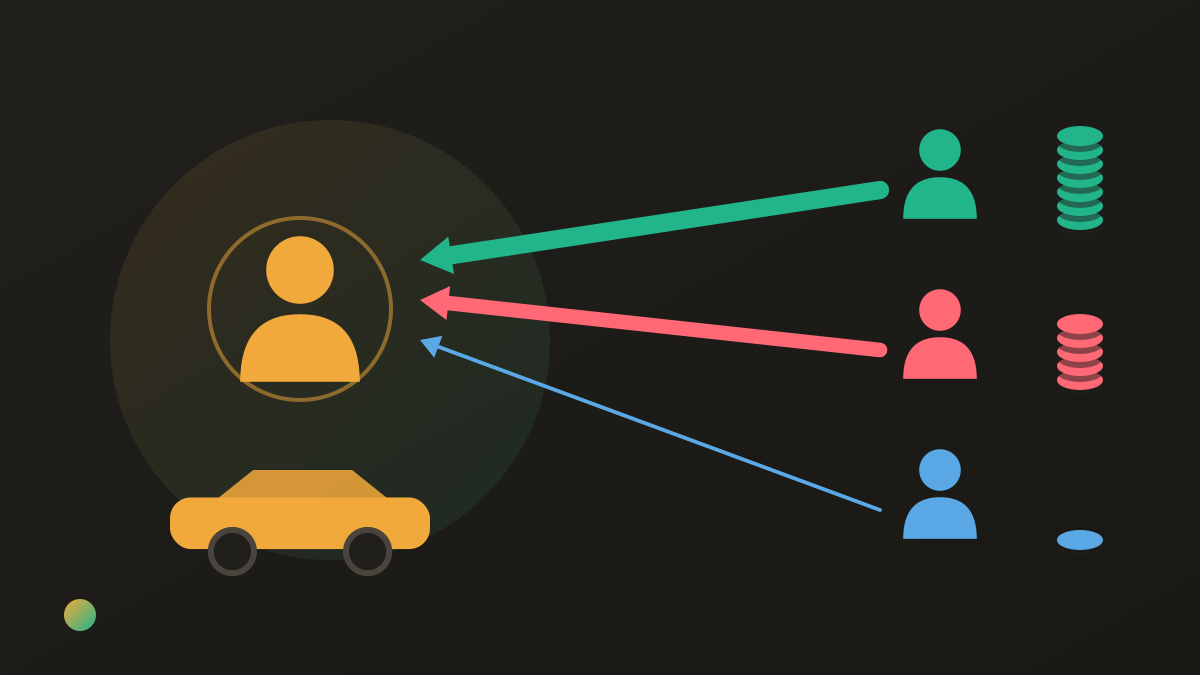
The work is what goes unnoticed: the friend who brings the car and drives the whole way gives the trip more than anyone. The money is what turns awkward if nobody writes it down. Treat the two separately — name who takes each job, log who paid each cost — and most road-trip friction never starts.
The road trip checklist for the car
Do this a few days before you leave, so there is time to fix what you find.
- Tyre pressure and tread on all four tyres, plus the spare
- Jack and wheel wrench in the car, and someone knows where they are
- Oil, coolant and washer fluid topped up
- Headlights, brake lights and indicators working
- Wipers that clear the screen without streaking
- Battery that starts the car first time on a cold morning
- Phone mount and a charging cable that reaches the front and back seats
- Any kit the countries on your route require in the car (check before you go)
- A full tank before you set off
Documents and bookings
Paperwork is where a trip stops dead, usually at a rental counter or a border.
- A valid driving licence for everyone who will drive
- Insurance that covers every driver, not only the owner
- Registration papers, or the rental agreement with every extra driver named on it
- Breakdown cover number saved in more than one phone
- Toll pass, vignette or road-charge registration if the route needs one
- ID or passports if you cross a border
- Accommodation and parking confirmations saved offline
Road trip checklist: packing
Split the packing into the car kit, which the group shares, and personal bags, which each person handles. The car kit is where duplicates and gaps happen.
The car kit
- Water and snacks for the first stretch
- A cooler and ice packs
- A first-aid kit
- Paper towels, wet wipes and a bin bag
- A blanket and a torch
- A power bank
- Offline maps and the playlist downloaded before you lose signal
Each person’s bag
- Medicine and anything you need daily
- Layers for a car that is too cold for one person and too warm for another
- Sunglasses, a charger, ID and a bank card
- A pillow if you plan to sleep on the way
A shared who brings what list solves the duplicate-cooler problem: each shared item gets one name next to it, and nothing on the car kit is left for “someone”.
The drive itself
The route is the easy part; the questions people avoid are about who does what.
- Whose car. Settle it first; everything else depends on it.
- Who drives which stretch. Agree shifts of two to three hours and swap at planned stops.
- Who navigates. Usually whoever is in the passenger seat, and they also run the music.
- Where you stop. Fuel, food and toilets, roughly every two to three hours.
- The fuel rule. For example, refill when the tank drops to a quarter, wherever you are.
- Departure time. Say it as a time, not “early”.
If the trip is longer than a weekend, planning a group trip with friends covers dates, budgets and bookings before any of this.
Money rules to agree before you leave
The item most groups skip. Agree these out loud before anyone pays for anything:
- What is shared. Fuel, tolls and parking, almost always. Food and the place you stay, usually. Souvenirs and personal snacks, never.
- The driver pays a share too. Under the usual convention, the driver is one of the people in the car.
- A car allowance, or not. If the owner gets something for wear and tear, make it a flat number agreed now.
- Who logs costs. Whoever pays logs it, there and then, with who was in the car.
- Fines. The driver who earned one usually keeps it.
- When you settle. Once, at the end of the trip, not at every stop.
Fuel, tolls and parking: the expenses
The arithmetic deserves its own page, and it has one: how to split gas money on a road trip has the fuel formula, the per-leg split for a friend who joins halfway, and when a car allowance makes sense. The short version is that fuel, tolls and parking are the cost of moving the car, so they follow one rule: divide each stretch among the people who were in the car for it, driver included. If people join or leave along the way, split by leg; if the same four ride the whole way, one equal split covers it.
A road trip usually sits inside a bigger weekend, with a rental and dinners alongside the fuel. The fair way to split a group trip covers those, and a travel kitty or splitting as you go helps decide how to handle the small daily costs.
A worked example: four friends, one weekend
Priya brings her car. Jonah and Mei share the driving. Leo takes the snacks and water. Over the weekend:
| Cost | Paid by | Shared by | Amount |
|---|---|---|---|
| Gas, two fill-ups | Priya | all four | $96 |
| Tolls | Jonah | all four | $18 |
| Parking at the coast | Mei | all four | $24 |
| Snacks and water | Leo | all four | $42 |
| Total | $180 |
That is $45 a head. Set what each person paid against $45:
- Priya paid $96 → is owed $51
- Jonah paid $18 → owes $27
- Mei paid $24 → owes $21
- Leo paid $42 → owes $3
The balances add to zero: 51 − 27 − 21 − 3 = 0. It settles in three transfers, all to Priya: Jonah sends $27, Mei $21 and Leo $3. With one person owed and three owing, three is the minimum.
Notice what the table does not show: Priya’s car and Jonah and Mei’s hours behind the wheel. The group agreed no car allowance, so those stay as work rather than money. They were still the biggest contributions of the weekend, which is why they belong on the list as tasks with names on them.
Where Donget comes in
Every Donget group has a Money | Tasks switch, so both halves of the checklist live in the same place. Add task puts each job on the Tasks side. In Who takes it? you leave it Open, so it goes Up for grabs, or hand it to one or more people. Priya takes “Bring a car” with I’ll take it. Jonah takes “Driving” and chooses Take it with Mei, so either of them can tick it. Leo takes “Buy snacks”, and when he taps Mark as done, Donget asks Spent money on Buy snacks?. Add expense opens the expense form with the title already filled in, and he types the $42.
On the Money side, each fuel stop, toll and car park is an expense with Paid by set to whoever paid, split Equally among the people in the car. Expenses can be added offline and sync later, which matters on roads with patchy signal; offline expense-splitting apps covers what that means. When All tasks done appears, Go to settle up shows the three transfers to Priya. Donget does not move the money; each person pays Priya however you normally pay each other, and Paid records the payment so the group closes at zero.
Frequently asked questions
What should be on a road trip checklist?
Five groups: car checks a few days before, documents, packing for the car and for each person, a plan for the drive itself, and the money rules everyone agrees before leaving.
What car checks should you do before a road trip?
Tyre pressure and tread, including the spare, plus oil, coolant, washer fluid, lights, wipers and the battery. Do it a few days early, so there is time to fix anything.
What do you need to pack for a road trip with friends?
A shared car kit (water, snacks, cooler, chargers, first-aid kit, blanket) and each person’s own bag. Put one name next to each shared item so nothing is doubled or forgotten.
How do you split costs on a road trip with friends?
Fuel, tolls and parking are split among everyone in the car, driver included. Whoever pays logs it, and the group settles once at the end in as few transfers as possible.
Should the person whose car it is pay less?
Not by default. The owner usually takes an equal share. Some groups add a small, flat car allowance; agree it before you set off.
Who should drive on a road trip?
Everyone who is insured for the car and comfortable driving it. Agree shifts, swap at planned stops, and let the passenger seat navigate.
The bottom line
A road trip checklist is half jobs and half money. Check the car a few days early, get the documents straight, pack one shared car kit with a name on every item, agree who drives which stretch, and say the money rules out loud before the first fill-up. Then log each cost as it happens and settle once, at the end.
Download Donget free and put the car, the driving and the gas money in one group before you leave the driveway.