A fair way to split rent with a couple and single flatmates
A fair way to split rent with a couple is to agree how much follows bedrooms and how much follows people. A room-and-person example shows the trade-off.

Three bedrooms, four adults. Alex and Riley share one room; Jo and Sam have one each. Divide the rent by three and the couple pays the same together as either single flatmate. Divide it by four and each half of a shared bedroom costs as much as a private one. Neither starting point answers the whole question.
A fair way to split rent with a couple is to agree what part follows private rooms and what part follows people using shared space. Allocate those two parts separately, then combine each adult’s amounts. Keep household bills separate, and treat the proportions as a shared choice rather than a rule that every home must follow.
Why “by room” and “by person” give different answers
A bedroom allocation recognises private space. Two adults sharing a room divide one room’s allocation between them. A per-person allocation recognises each adult’s use of the rest of the home. Under that method, a couple has two allocations.
Neither calculation measures every benefit of living together. A couple sharing a bedroom is giving up private space; an extra adult still uses the kitchen and living room. The point of showing both methods is to make the trade-off visible before choosing a number.
Keep the discussion about the home. You do not need assumptions about anyone’s gender, income or relationship to compare these options.
Choose a room-and-person rent split together
Decide two things: how to value the bedrooms relative to one another, and what proportion of the total follows those rooms. The remainder follows the adults. You might put all the rent through either method, or choose a mixture.
For unequal rooms, agree weights for features you actually value before applying them to the room portion. Splitting rent when the rooms differ explores those differences. Do not also add a separate room premium afterwards unless you deliberately revise the calculation: that would count the same advantage twice.
Write the proposal as individual amounts and a household total. “The couple pays more” is ambiguous: more together, or more per person? A table makes both answers explicit.
A worked example: three equal bedrooms and four adults
Alex, Riley, Jo and Sam agree to allocate 60% of their €2,400 monthly rent by bedroom and 40% by person. The three bedrooms are equivalent for this example. Alex and Riley agree to divide their room allocation equally between themselves.
The room part is €2,400 × 60% = €1,440. Divided between three rooms, that is €480 per room: €240 each for Alex and Riley, €480 each for Jo and Sam.
The person part is €2,400 × 40% = €960. Divided between four adults, it is €240 each.
| Adult | Room part | Person part | Rent share |
|---|---|---|---|
| Alex | €240 | €240 | €480 |
| Riley | €240 | €240 | €480 |
| Jo | €480 | €240 | €720 |
| Sam | €480 | €240 | €720 |
| Total | €1,440 | €960 | €2,400 |
Alex and Riley pay €960 together, which is 40% of the rent. Jo and Sam each pay €720, or 30%. Each person in the couple pays less than either single flatmate; the couple together pays more than either one.
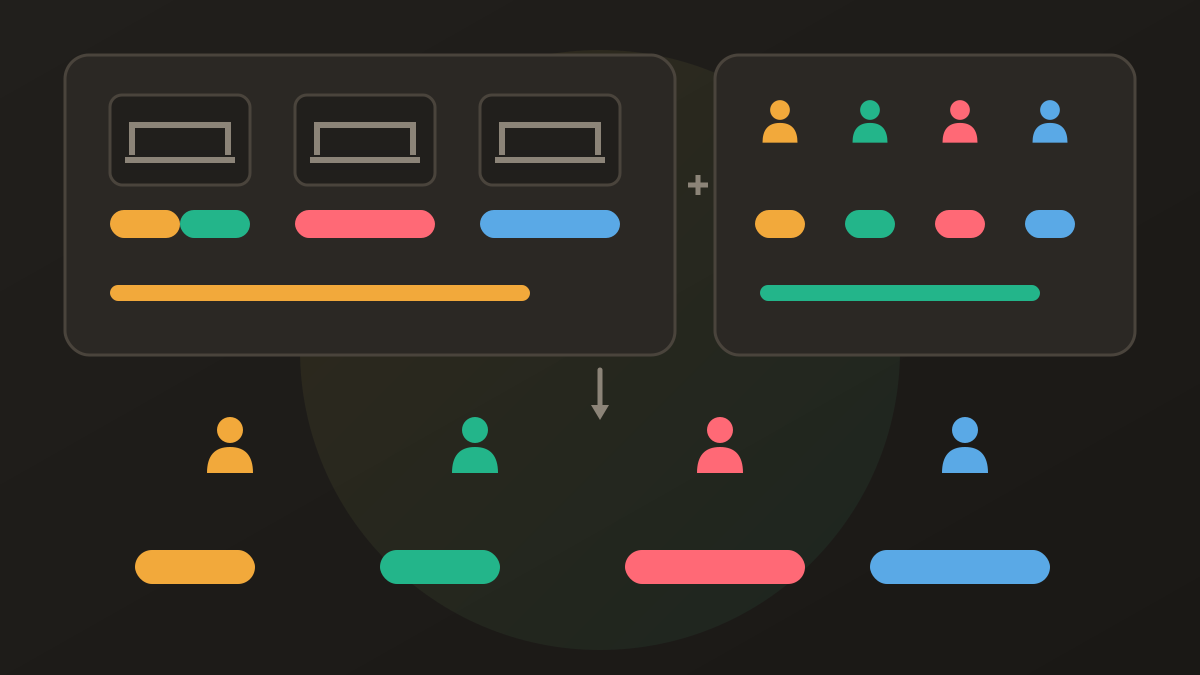
The choice of 60% is illustrative. It is not a measured value of the bedrooms or a standard household entitlement.
Compare the alternatives before you agree
On the same €2,400 rent, an entirely per-person split is €600 each. An entirely equal-room split is €800 per bedroom: €400 each for Alex and Riley and €800 each for Jo and Sam. The mixed model sits between those two choices.
This comparison gives people something concrete to discuss. If the objection is about sharing the bathroom, talk about the person portion. If it concerns a private balcony, revisit the room weights. Changing a percentage without naming the concern usually just moves the disagreement.
A proposed split is ready when every adult can explain it, the amounts total the rent and everyone accepts it. Until then, it is a proposal rather than an agreed balance.
Keep bills separate and settle actual payments
For this month, the four also agree to split €240 of household bills equally: €60 each. Jo pays the €2,400 rent, and Sam pays those bills. Alex and Riley have not paid anything yet.
| Adult | Paid | Rent plus bills share | Balance |
|---|---|---|---|
| Alex | €0 | €540 | −€540 |
| Riley | €0 | €540 | −€540 |
| Jo | €2,400 | €780 | +€1,620 |
| Sam | €240 | €780 | −€540 |
| Total | €2,640 | €2,640 | €0 |
Alex pays Jo €540, Riley pays Jo €540 and Sam pays Jo €540. Jo receives €1,620, closing the one positive balance. Three transfers are the minimum because three adults each need to make a payment. Sam’s bill payment has already reduced Sam’s amount due; nobody adds a second €60 bill payment afterwards.
Keeping the allocations and actual payer separate is the same principle used in splitting rent and household bills.
When the household changes
Revisit the calculation if someone changes rooms, the number of adults changes or everyone agrees that the old proportions no longer fit. Choose when the revised agreement starts and record it clearly. A new month is an easy review point, but not an automatic reason to change the weights.
Regular visits are a different starting question. If the concern is a partner staying over and adding shared costs, discuss those costs and the use of the home before assuming the visitor is part of this ongoing rent model.
Where Donget comes in
In Donget, record the rent with Jo as Paid by, then choose Amounts and enter €480, €480, €720 and €720 for the four adults. Add the household bills separately, paid by Sam and split Equally. Other agreements can use Shares or Percent; the expense split methods explain their different uses.
Settle up combines the entries into the three payments above. People pay through their usual method, then use Paid to record each payment. Donget does not choose the room values or the 60/40 agreement, and it has no recurring expenses: each new rent payment needs its own entry.
Frequently asked questions
What is a fair way to split rent with a couple?
Agree what the rent allocation recognises: private rooms, shared-space use or a mixture. A room-and-person model can give the couple one room allocation plus two individual allocations, but its proportions are a choice for everyone to approve.
Should a couple pay more rent than a single flatmate?
They may pay more together while each pays less individually. In the worked example, the couple contributes €960 together and each single flatmate €720; those amounts follow a chosen 60% room and 40% person allocation, not a universal rule.
Why not split the rent equally by person?
That is an option if everyone accepts it. It gives each adult the same rent share, but does not distinguish someone with a private bedroom from two people sharing one, so compare it with a room-based option before deciding.
How do we handle a couple in a larger bedroom?
Agree the relative room values first, then allocate the room part of the rent using those weights. Split the person part separately, and show each adult’s final amount so that a room premium is not counted twice.
Should household bills use the same split as rent?
They do not have to. You can agree equal per-person bills while using a room-and-person rent split, and keep personal purchases out; enter each cost with the people and amounts you agreed it covers.
Does a rent-splitting app choose the room and person proportions?
No. You choose the proportions and calculate the individual shares, then enter those amounts. The app records the agreement and payments; it does not decide housing terms or what anyone is required to pay.
The bottom line
Show the room allocation, the person allocation and each adult’s final amount. Compare alternatives before agreeing a split, keep household bills distinct, and use actual payments to calculate the balance. The formula helps people assess a choice; it does not make that choice for them.
Download Donget free and record the rent shares your household has agreed.