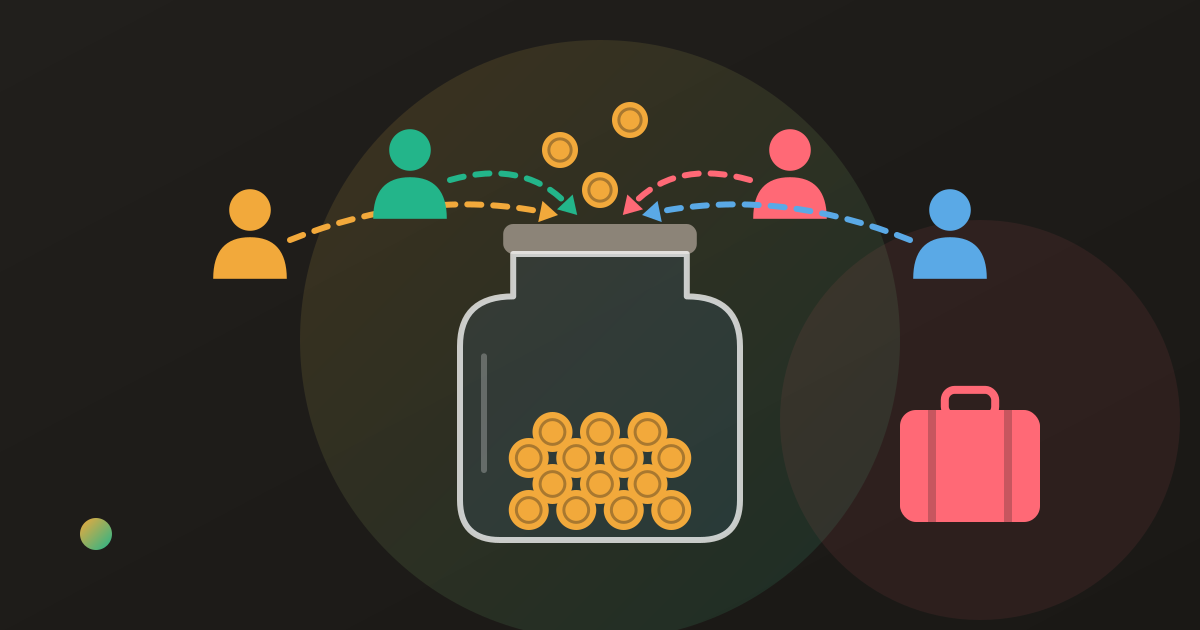
How to split team expenses (free Splitwise alternative)
How to split team expenses without the awkwardness: shared costs at work, why apps built for friends break in the office, and a free Splitwise alternative for business.
Friday, 12:40. You put the team lunch on your own card, because the company card was in a drawer two floors up and the queue was moving. Six colleagues. £94.20. A mental note that you’ll sort it later.
It is now Wednesday. You have sorted nothing. What you have done is draft four different Slack messages and delete all of them, because none of them made you sound like a person who is relaxed about £15.70.
That’s the real problem with team expenses. It was never the arithmetic.
Why apps built for friends get strange at work
Splitwise, and most apps like it, were designed around a specific social contract: a group of friends who trust each other, who will see each other again, and who accept a running tally as a normal part of the friendship.
Almost none of that survives contact with an office.
Nobody wants to be the debt collector. With friends, a nudge is banter. With the colleague who sits opposite you and is two levels above you, a nudge is a small career decision. Most people simply eat the cost instead, which is how one person ends up quietly subsidising the team for a year.
The payer rotates, but the awkwardness doesn’t. In a friend group, whoever’s turn it is pays and it evens out over a decade. Teams don’t have a decade. They have a quarter, a reorg, and a leaving-do.
People leave. A friend who owes you £12 owes you £12 forever. A colleague who owes you £12 hands in their notice, and now there’s an outstanding balance attached to someone whose Slack account is deactivated. Consumer splitting apps have nothing sensible to say about this.
Receipts have a second job. Between friends, the receipt is evidence in a disagreement nobody expects to have. At work, the receipt might need to survive long enough to be attached to a claim. An app that treats the photo as disposable is fine for a picnic and useless for anything reimbursable.
Everyone’s somewhere else. The moment your team is spread across countries, a single lunch can involve two currencies and a card that quietly added its own exchange rate.
First, work out which problem you actually have
Most “team expenses” confusion comes from four different problems wearing the same name. They need different tools, and picking the wrong one is why people bounce off every app they try.
1. Company money you fronted. You paid for the client dinner and the company owes you back. This is not a splitting problem at all — it’s a reimbursement problem. You need a receipt and an expense claim, and you should be using whatever your finance team has set up, even if it’s ugly. Putting this in a splitting app loses the receipt and creates a balance that will never be settled, because the company isn’t in the group.
2. Shared costs the company won’t cover. The team lunch. The leaving gift. The coffee kitty. The Friday round. Nobody is claiming this back, so it has to be divided between actual humans. This is a splitting problem wearing a work lanyard, and it’s the one that quietly generates the most resentment.
3. Costs between people who aren’t in the same company. Two freelancers sharing a studio. Co-founders splitting a subscription before there’s a company bank account. An agency splitting a booth at a conference with a partner. Real business expense tools assume an employer; there isn’t one yet.
4. One person’s card, everyone’s subscription. The design tool, the shared drive, the transcription service — all on one founder’s personal card since 2023, with a vague understanding that it’ll be sorted out at some point.
Categories 2, 3 and 4 are the ones people search for a “Splitwise alternative for business” to solve. Category 1 isn’t a splitting problem, and no splitting app will do it well — including ours.
What a team-shaped splitting app needs
If you’re picking something for categories 2–4, this is the short list that actually matters day to day:
- No cap on how many expenses you can add. A team logs more than a friend group does, and it logs in bursts — a conference generates fifteen entries in three days. An app that meters your expenses will fail you precisely when you’re busiest. (More on that in what you actually give up on a free plan.)
- Splits that aren’t just “equally”. The team lunch where two people had the set menu and one had a starter is not an equal split. Neither is a leaving gift where the person leaving pays nothing. You want all five ways to split — equally, by exact amounts, by percentage, by shares, and item by item.
- Receipt capture that isn’t a premium feature. Snap it, and let the app pull the total out. If receipt scanning sits behind a subscription, people won’t use it, and then nobody can remember what the £94.20 was.
- Multiple currencies in one group. Non-negotiable for a distributed team.
- A settle-up that minimises payments. Six people who each owe two other people is fifteen possible transfers. Good software turns that into four.
- Free for everyone in the group. This is the one people miss. If your app charges per person, you are now asking six colleagues to each make a purchasing decision before you can be paid back for lunch. You will not be paid back for lunch.
A worked example, because the abstract version is useless
Six people. Lunch is £94.20. Priya doesn’t drink, so she skipped the £18 bottle of wine. Tom is leaving, and the team agreed his lunch is on them.
The equal split — £15.70 each — is wrong twice over, and everyone at the table can feel it’s wrong, which is exactly why nobody says anything.
Here’s the version that’s actually fair:
- Log the £76.20 of food as one expense, split by shares: five people at one share each, Tom at zero. That’s £15.24 each for the five.
- Log the £18 of wine as a second expense, split equally between the four who drank it. That’s £4.50 each.
Priya pays £15.24. The four drinkers pay £19.74 each. Tom pays nothing. It took about forty seconds and nobody had to say the sentence “well, I didn’t have the wine.”
That second sentence is the whole product category, honestly. These apps exist so that nobody has to say it out loud.
The colleague who leaves owing you money
The one genuinely unsolvable case. Some practical damage limitation:
- Settle at natural boundaries. End of month, end of a trip, end of a project. Balances that live longer than a quarter don’t get paid; they get forgotten and then resented.
- Make the payer rotate visibly. If the app shows a running balance, “you paid last time” stops being a claim someone has to make and becomes a fact on a screen.
- Keep a leaving-do rule. The simplest one: the person leaving doesn’t pay. Agree it once, and you never have to negotiate it again while someone’s standing there.
- Don’t let one person fund the team. If the same name is always the payer, the balance isn’t a balance — it’s an interest-free loan they didn’t offer.
Where Donget fits
Donget is a free expense splitting app, and categories 2, 3 and 4 are squarely what it’s for. It won’t file your company expense claim, and we’d rather say that than sell you something that doesn’t work.
For shared team costs, it gives you:
- Unlimited expenses, with no daily cap and no ads sitting between you and the balances.
- Five ways to split, so the wine and the leaving gift can both be handled properly.
- Free AI receipt scanning — photograph it at the table, before the receipt goes in a pocket and through a wash cycle.
- Multiple currencies in a single group, for teams that aren’t in one place.
- A settle up that works out the fewest payments to make everyone even.
- Free for every member, so nobody has to buy anything to pay you back.
There’s more detail on the office use case page, and if you’re mid-comparison, a straight Donget vs Splitwise breakdown.
Setting it up on Monday
- Create one Group per real unit — “Design team”, not “Lunch”. Groups that map to a thing that already exists get used; groups that map to an occasion get abandoned.
- Add everyone, including the person who “doesn’t really do apps”. One holdout turns the whole thing back into a spreadsheet.
- Agree two rules out loud, once: whoever pays logs it immediately, and we settle at the end of the month. That’s the entire process.
- Settle up on the last Friday. Four transfers, no messages beginning “sorry to be annoying, but…”.
The point isn’t tidy accounts. It’s that £15.70 stops being something you think about on a Wednesday.
Frequently asked questions
What’s the best app for splitting team expenses?
The best app lets everyone log unlimited expenses for free, splits more than just equally (so the set menu and the leaving gift are handled properly), captures receipts without a paywall, handles multiple currencies, and works out the fewest payments to settle. Donget does all of this free for every member of the group.
Can you use Splitwise for business or teams?
You can use Splitwise-style apps for shared team costs the company won’t reimburse — team lunches, leaving gifts, the coffee kitty. They’re not built for reimbursable company expenses, which belong in your finance team’s claims process, not a splitting app.
Is Splitwise free for teams?
Splitwise has a free tier, but it caps how many expenses you can add per day and puts receipt scanning behind Pro — awkward for a team that logs in bursts during a conference. A free alternative with no daily limit avoids that wall.
How do you split team expenses fairly at work?
Split by what people actually consumed, not a flat per-head figure: use shares or exact amounts so someone who skipped the wine or is being treated pays the right amount. Settle at natural boundaries — end of month, end of a trip — so balances never outlive the goodwill.
What’s the difference between splitting team expenses and an expense claim?
An expense claim is money the company owes you back — that needs a receipt and your employer’s reimbursement process. Splitting is for costs shared between actual people the company won’t cover. A splitting app handles the second, not the first.
Download Donget free and get your team’s shared costs off your personal card.