What does “going Dutch” mean? Bill-splitting customs around the world
Going Dutch means each person pays for their own share of a meal or outing, rather than one person paying for everyone. Where the phrase comes from, and how bill splitting works around the world.

The plates are cleared, the bill arrives, and someone says, “Shall we go Dutch?” Half the table nods. The other half is quietly unsure whether that means paying for what they ordered or dividing the total — and the two can differ by several euros a head.
The phrase is simple; the custom behind it is not. Going Dutch means each person pays for their own share — usually their own food and drink — instead of one person paying for everyone. It is not quite the same as splitting the bill evenly, and many phrases translated as “going Dutch”, such as Japan’s warikan, actually mean equal shares.
What “going Dutch” means
In one sentence: to go Dutch is to pay your own way on a shared outing. Dictionaries define the related “Dutch treat” as a meal or entertainment where each person pays for themselves. In practice, English speakers stretch it: some mean “pay for exactly what you had”, others mean “split it”, and plenty use it to signal only that nobody is treating anyone.
That ambiguity is where most awkward moments come from, so it is worth knowing the three options it can stand for.
Where the phrase comes from
The going Dutch origin story most people have heard is a 17th-century one: England and the Dutch Republic were naval and trading rivals, and English picked up several insults built on “Dutch” in that period, such as “Dutch reckoning” and “Dutch feast” — a party at which the host gets drunk first.
The dated evidence for this phrase points somewhere else. “Dutch treat” is recorded in American English from around 1870, a “treat” in which nobody is treated, and “go Dutch” follows by the early twentieth century. So the phrase is American and much younger than the rivalry, even if it borrowed the older habit of using “Dutch” to mean “not the real thing”. Some dictionaries still label “Dutch treat” sometimes offensive; “splitting the bill” avoids the question entirely.
Going Dutch, splitting evenly, or one person pays
There are three common ways to settle a shared meal:
- Going Dutch — each person pays for their own plate and drinks, plus a fair share of anything shared.
- Splitting evenly — the total is divided by the number of people, whatever each one ordered.
- One person pays — as a treat, or on the understanding that the others pay them back.
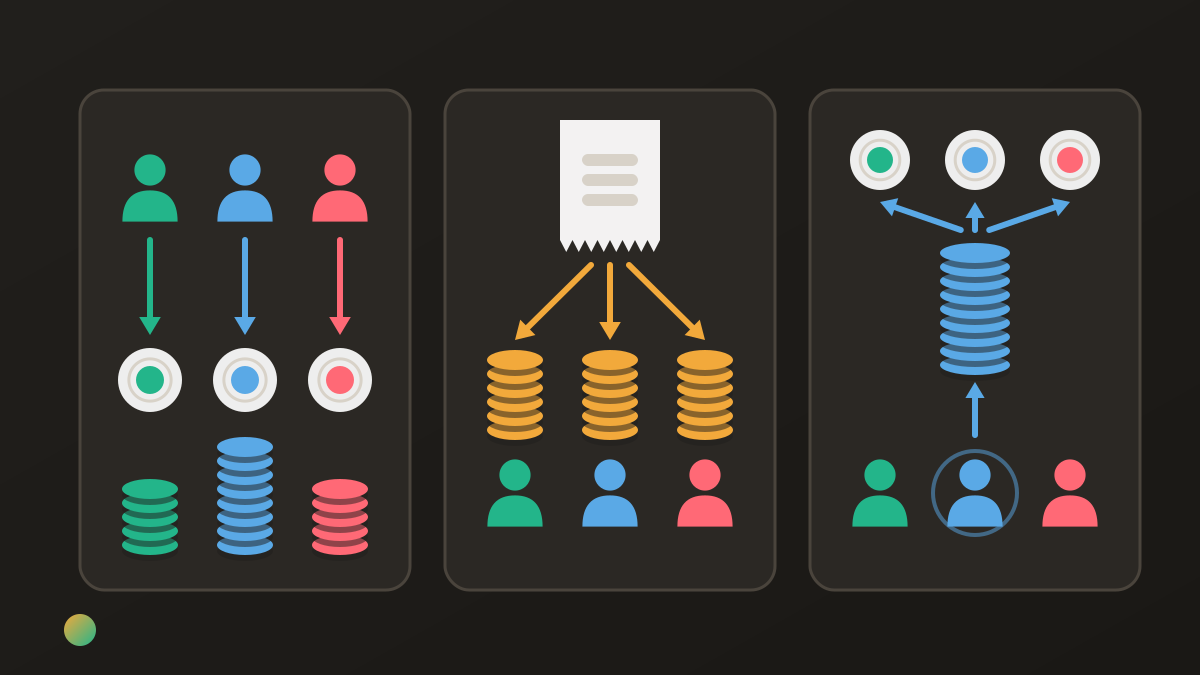
Even splitting is quick and fair when orders are similar. Going Dutch is fairer when they are not. Behind the scenes these are just two of the five ways to split an expense, and splitting a restaurant bill when not everyone ate the same covers the hybrids.
A worked example: three people, two answers
Lena, Marco and Sofia have dinner. Lena’s main and drink come to €22, Marco’s to €35 and Sofia’s to €21, and they share a €12 starter. The bill is €90.
| Own order | + third of starter | Going Dutch | Split evenly | Difference | |
|---|---|---|---|---|---|
| Lena | €22 | €4 | €26 | €30 | pays €4 more evenly |
| Marco | €35 | €4 | €39 | €30 | pays €9 less evenly |
| Sofia | €21 | €4 | €25 | €30 | pays €5 more evenly |
| Total | €78 | €12 | €90 | €90 |
Both methods collect €90. The even split moves €9 from Lena and Sofia to Marco — trivial for one dinner, noticeable over a year of them. If Marco had offered to pay the whole €90 as a treat, nobody would owe anything; if he paid it just to keep things moving, going Dutch means Lena sends him €26 and Sofia €25. If the bill also carries service or tax, it scales with each order — splitting tax and tip proportionally shows how.
Bill splitting etiquette around the world
Customs vary by region, age, occasion and family, so read these as common patterns, not rules.
Japan. Among friends, warikan (割り勘) — dividing the bill equally between the people paying — is common. In business or more formal settings the senior person or the host often pays.
South Korea. Deochipei (더치페이) is a Korean coinage from the English words “Dutch” and “pay”, meaning each person pays their own way or the cost is shared. Enppang (엔빵), from “n” as in n ways, means everyone contributes an equal part.
Italy. Pagare alla romana, “paying the Roman way”, commonly means splitting the total equally between everyone at the table.
Spain. Pagar a escote means each person pays their part of a common expense.
Iran. Each person’s portion of a group cost is their dong (دنگ); dictionaries record the share sense under dāng (دانگ), a word that literally means one sixth. Suggesting everyone pays their share is dongi hesab konim (دنگی حساب کنیم), “let’s split it”.
Turkey. Alman usulü, “the German way”, means paying separately.
Saudi Arabia. Friends who meet regularly often collect a qatta (القطة) — money gathered from everyone present to cover the gathering’s costs, much like a kitty.
Germany. “Zusammen oder getrennt?” — together or separate? — is the standard question at the end of a restaurant meal, and paying separately is routine.
The Netherlands. It is common for one person to pay and then send the others a payment request through an app such as Tikkie, or for everyone to pay their own share.
The United States. Among friends, splitting evenly is common when orders cost about the same; when one person pays, the others often pay them back through a payment app.
Is it rude to split the bill?
Usually not. Among friends and colleagues of similar standing, splitting is the default in many places, and insisting on paying can make others feel indebted. It gets delicate in three situations: when someone clearly invited the others (“let me take you out”), when the meal celebrates one person — see who pays on a birthday dinner — and where custom expects a senior person or host to pay. Couples have their own version of the question, which whether couples should split bills 50/50 takes on.
How to propose it politely
Say it before anyone orders, not when the bill lands: “Shall we each pay for our own?” or “Shall we just split it evenly?” Naming the method early lets the person on a tight budget order accordingly without explaining why. If one person orders far more, offer to go Dutch rather than waiting to be asked. And if someone pays for everyone to keep things moving, settle the same day; settling up without the awkwardness has the habits that help.
Where Donget comes in
Donget handles all three methods on one bill. Paid by records who covered it. For an even split, choose Equal. To go Dutch, choose Amount and enter each person’s total, or tap Scan receipt and let each person Claim a share of the dishes they had; whoever claims pays only for what they claimed, and anything left unclaimed is split equally between those who claimed nothing — or between everyone, once everyone has claimed something. When a group eats out often, Settle up combines the balances into the fewest transfers, and Paid marks each one done. Donget does not move money — the transfer itself happens however you normally pay each other.
Frequently asked questions
What does going Dutch mean?
Each person pays for their own share of a meal, drink or outing instead of one person paying for everyone. Usually it means paying for what you ordered, though some people use it loosely for any split.
Where does the phrase “going Dutch” come from?
It grew out of “Dutch treat”, recorded in American English from around 1870. It is often linked to the 17th-century Anglo-Dutch rivalry, but the dated evidence for this phrase is American and much later.
Is going Dutch the same as splitting the bill evenly?
Not quite. Going Dutch means paying for your own share; splitting evenly divides the total by the number of people. They match only when everyone ordered about the same.
Is it rude to split the bill?
Usually not among friends and colleagues of similar standing. It can feel awkward when someone invited the others, at a celebration for one person, or where a senior person or host is expected to pay.
How do people split the bill in Japan?
Among friends, warikan (割り勘) — dividing the bill equally between the people paying — is common. In business or formal settings the senior person or host often pays.
Is “going Dutch” offensive?
It is rarely meant as an insult, but some dictionaries label “Dutch treat” as sometimes offensive. “Splitting the bill” or “paying separately” says the same thing.
The bottom line
Going Dutch means paying your own way, and it is only one of several ways tables settle up around the world — from equal warikan in Tokyo to a qatta among friends in Riyadh. Whatever the custom, the awkward part is the same: not knowing which method is in play. Name it before ordering and the bill becomes arithmetic.
Download Donget free and split the next dinner your way — evenly, by dish, or one pays and the rest settle up later.